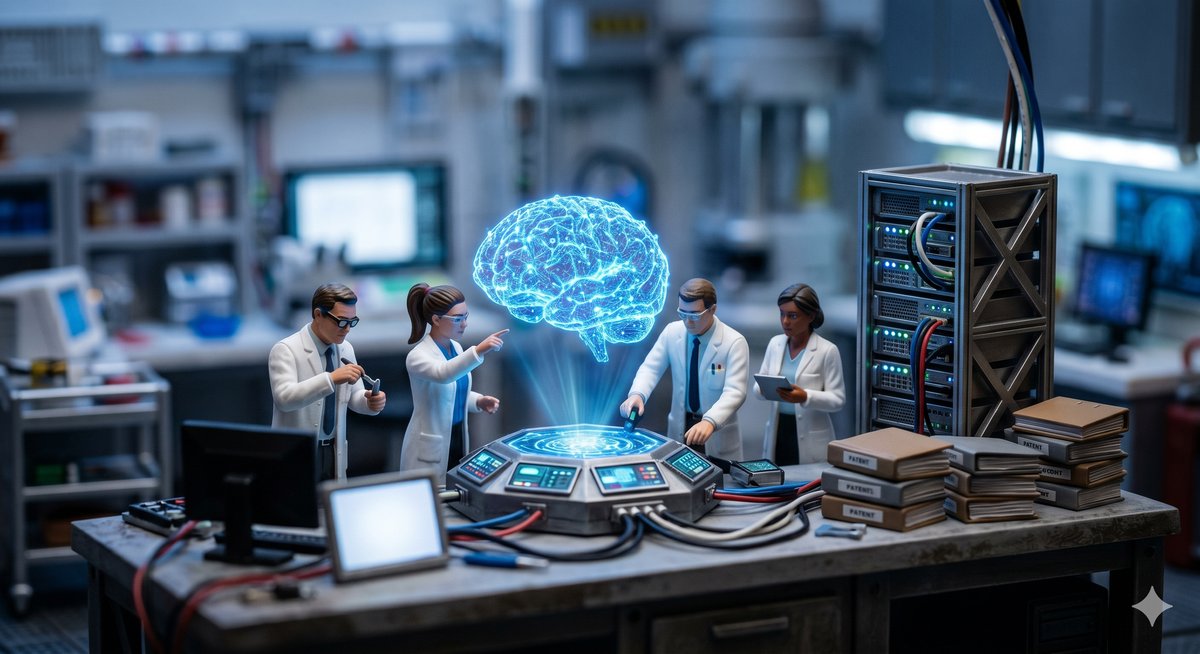
OpenAI, best known as the company behind ChatGPT, has sharply accelerated its patent activity since 2023. As of April 2026, the company holds 110 global patents across 58 unique families — 42 granted, 102 active, with a 93% activity rate. Independent analyses by GreyB and Parola Analytics both point to a portfolio expanding beyond pure AI software into hardware and embedded systems. Read alongside reports of a 2026 consumer AI device co-designed with former Apple CDO Jony Ive, the patent record tells a coherent story of a company systematically building IP assets for a hardware pivot.
The 110-Patent Portfolio: A Snapshot
OpenAI’s 110 global patents span 58 unique families, with 96 of those filed in the United States and just one at the EPO — a geographic concentration that reflects the company’s U.S.-centric R&D base. The annual filing cadence tells its own story: from seven or fewer applications per year through 2022, filings jumped to 26 in 2023 and 42 in 2024. With patent applications typically taking up to 18 months to publish, the 30 applications filed in 2025 will not appear in the public record until late 2026 or 2027, meaning the portfolio’s current footprint is already larger than the numbers suggest.
Technology Landscape: Hardware Categories Emerging
The dominant patent classifications are G06F (digital data processing), G06N (machine learning), G06V/G06T (image and video processing), and H04L (network communications) — a distribution consistent with a generative AI software company. What stands out as a recent development is the appearance of G11C (semiconductor memories) and H10B (electronic memory devices) in the portfolio. These classifications relate to custom memory architectures and on-device inference chips — territory unusual for a company that has operated solely as a software provider.
Five Flagship Patents and Their Industry Reach
Among OpenAI’s 110 patents, five stand out for their technical scope and competitive impact. US11922550B1 (hierarchical text-conditional image generation) has received 36 citations from competitors including Google and Adobe, making it the most-cited patent in the portfolio. US11983806B1 (image generation with machine learning) follows with 27 citations, and US11886826B1 has received 15. US12079587 (multi-task automatic speech recognition) and US12051205 (multimodal image interaction systems) round out the flagship set.
Comparing OpenAI, Google, and Apple
A raw count comparison puts OpenAI at a significant disadvantage: Google holds thousands of patents in the generative AI and LLM space alone, while Apple has built a multi-hundred-patent portfolio covering on-device machine learning, voice processing, and AI-integrated interfaces. However, head counts are a misleading metric when the companies entered the patent race at different times.
OpenAI began serious patent filing only in 2023. Parola Analytics maps the acceleration to the integration of GPT models into Microsoft products and the expansion of API partnerships with companies such as Spotify, Zillow, and Mattel — a commercial pivot that coincided with a strategic decision to begin building an IP moat. Qualitatively, OpenAI’s portfolio is concentrated on the core technologies of generative AI: image generation, language modeling, and multimodal processing. This is a deliberate, focused strategy that contrasts with Google’s much broader, diversified patent base — and suggests OpenAI is building depth where it matters most rather than breadth for its own sake.
The Hardware Signal in the Patent Data
The G11C and H10B patent classifications suggest OpenAI may be developing custom silicon or memory architectures to accelerate on-device inference. The strategic context makes this plausible: OpenAI acquired io Products Inc. (a hardware design firm) in 2024, committed to a $38 billion AWS infrastructure deal, and acquired Windsurf for enterprise coding tools. Trademark filings pointing to consumer devices and robotics have also been reported, consistent with the anticipated 2026 AI device designed with Jony Ive’s studio.
There are three strategic reasons why a software company builds hardware patents. First, IP covering proprietary chips, sensors, or interfaces creates barriers to imitation that software patents alone cannot provide. Second, patent portfolios give companies leverage in licensing negotiations with manufacturing partners and component suppliers — essential when entering a supply chain where incumbents hold extensive IP. Third, hardware patents are a prerequisite for the kind of vertically integrated hardware-software-services model that Apple has used for decades to capture premium margins and sustain competitive moats.
Patent Counsel and Filing Infrastructure
Finnegan Henderson Farabow Garrett & Dunner, with attorney Yelena Morozova overseeing core filings, handles the majority of OpenAI’s patent work. Finnegan is one of the largest dedicated IP law firms in the United States, with deep experience representing major technology clients. The choice of outside counsel signals that OpenAI is treating its patent portfolio as a material business asset rather than an afterthought.
From Research Organization to AI Device Ecosystem
The arc of OpenAI’s patent portfolio — near-zero before 2022, rapid acceleration from 2023, emerging hardware classifications by 2025 — mirrors the company’s broader transition from research nonprofit to commercial software vendor to aspiring hardware platform. The combination of high-citation generative AI patents, hardware-adjacent patent classifications, and a string of acquisitions and infrastructure partnerships constitutes a coherent IP strategy for a company that intends to sell not just API access, but integrated AI devices. Whether the 2026 device launch validates this reading remains to be seen — but the patent record will continue to document the strategy in real time.
この記事について
パテント探偵社 編集部
知的財産の世界で起きている出来事を、ジャーナリズムの手法で報道・分析する独立メディア。特許番号・法的根拠・当事者名を正確に記述しながら、専門家以外にも読みやすい記事を届けています。掲載内容は法的アドバイスではありません。