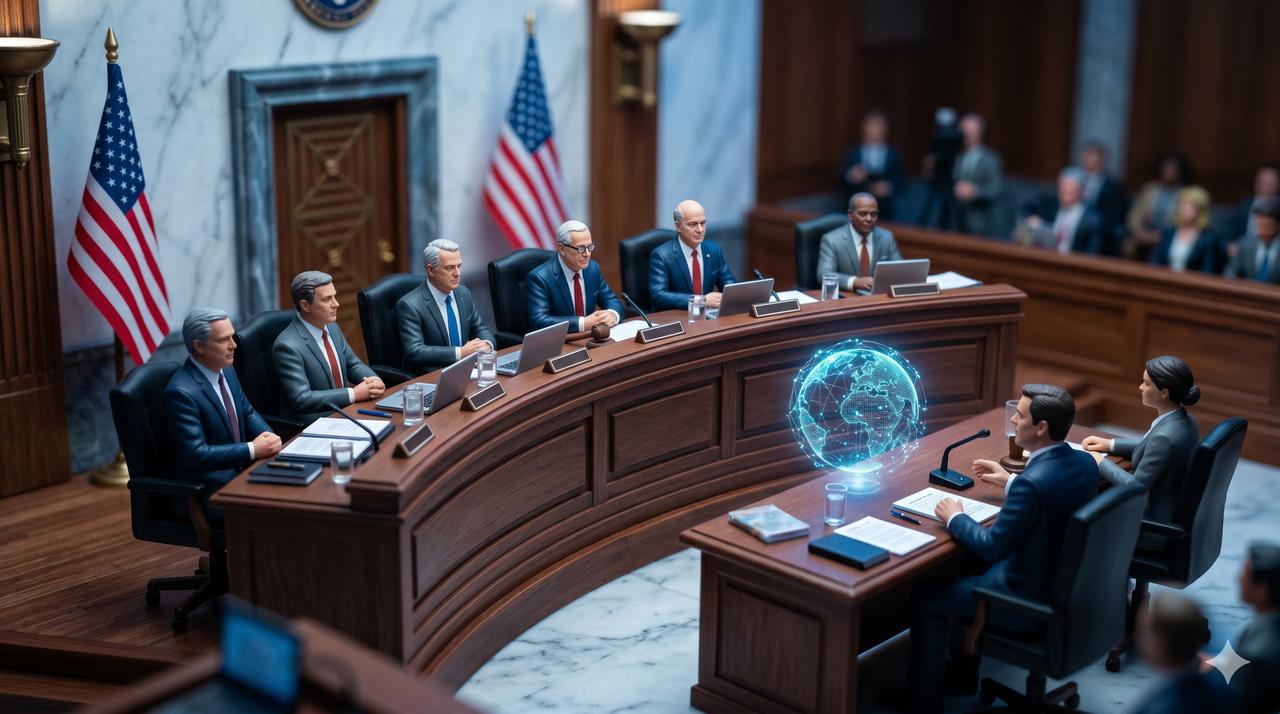
The United States Senate Judiciary Committee convened a full committee hearing on April 22, 2026, titled “Stealth Stealing: China’s Ongoing Theft of U.S. Innovation.” Senator Thom Tillis (R-NC) presided as chair in place of Senator Chuck Grassley and opened by warning that China’s intellectual property theft costs the United States an estimated $400 billion to $600 billion annually. Tillis further stressed that China is increasingly evolving from an imitator into an innovator, a shift that demands strategic recalibration by U.S. policymakers.
Four witnesses testified before the committee. A significant portion of the hearing focused on a technique called AI distillation — the use of a more capable AI model to improve a less capable competitor model. Helen Toner, Interim Executive Director of the Center for Security and Emerging Technology (CSET) at Georgetown University, explained that distillation is particularly difficult to detect and regulate because the same technique serves legitimate academic purposes. She noted that Google reported a surge of distillation incidents targeting its Gemini chatbot in February 2026. Toner’s recommended near-term countermeasure was to clarify existing antitrust guidance to discourage the practice when used for competitive purposes.
Senator Josh Hawley (R-MO) pushed the committee’s inquiry beyond traditional China-focused concerns, raising the question of whether U.S. AI companies might themselves pose risks analogous to those of adversarial foreign actors. Hawley noted that major AI companies argue they need freedom from IP restrictions to win the AI race against China, yet those same companies aim to displace millions of American workers, acquire vast stores of personal data, and restructure or destroy the existing IP system. “We would never allow a foreign corporation to pursue such goals,” Hawley said. “Will beating China do us any good if those companies succeed?” Toner responded that while maintaining U.S. leadership in AI is critical, absent meaningful government oversight and control, “the winner of any AI race between the U.S. and China is AI.”
Mark Cohen, Senior Technology Fellow at the Asia Society of Northern California and Senior Fellow at the University of Akron Law School’s Intellectual Property Institute, addressed structural weaknesses in the U.S. patent system. Cohen contrasted China’s approach — which has revised its patent examination guidelines 18 times and its patent law five times since 2000 — against a U.S. system encumbered by judicially-created limitations on patent eligible subject matter and injunctive relief. “If you are an inventor in key technology areas, your patent will be granted in China and possibly the EU, but not in the United States,” Cohen said, adding that this dynamic drives innovation offshore.
Tom Lyons, Co-Founder of the 2430 Group, proposed three enforcement reforms to address the inadequacy of existing deterrents. First, he called for strengthening penalties under the Economic Espionage Act to eliminate the financial incentive for IP misappropriation. Second, he advocated adopting a Qui Tam model that would allow private plaintiffs to share in financial recoveries. Third, he proposed creating a whistleblower bounty program modeled on the Dodd-Frank Wall Street Reform and Consumer Protection Act (2010). Lyons stated that the United States has not adequately addressed the infrastructure that enables misappropriation.
Senator Ted Cruz (R-TX) closed the hearing by presenting visual aids documenting patterns of Chinese IP misappropriation and warned that the consequences for the U.S. economy and national security are massive. Senator Dick Durbin (D-IL) questioned witnesses on whether the government should take a more active role in shaping AI development; Toner described the mismatch between AI’s strategic importance and the government’s limited involvement as “truly unprecedented.”
The hearing extended well beyond conventional IP misappropriation concerns, addressing the risks that U.S. AI companies themselves may pose to the IP system and the structural impact of U.S. patent eligibility doctrine on technological competitiveness. Hearing testimony is available on the Senate Judiciary Committee’s official website.
この記事について
パテント探偵社 編集部
知的財産の世界で起きている出来事を、ジャーナリズムの手法で報道・分析する独立メディア。特許番号・法的根拠・当事者名を正確に記述しながら、専門家以外にも読みやすい記事を届けています。掲載内容は法的アドバイスではありません。


コメント