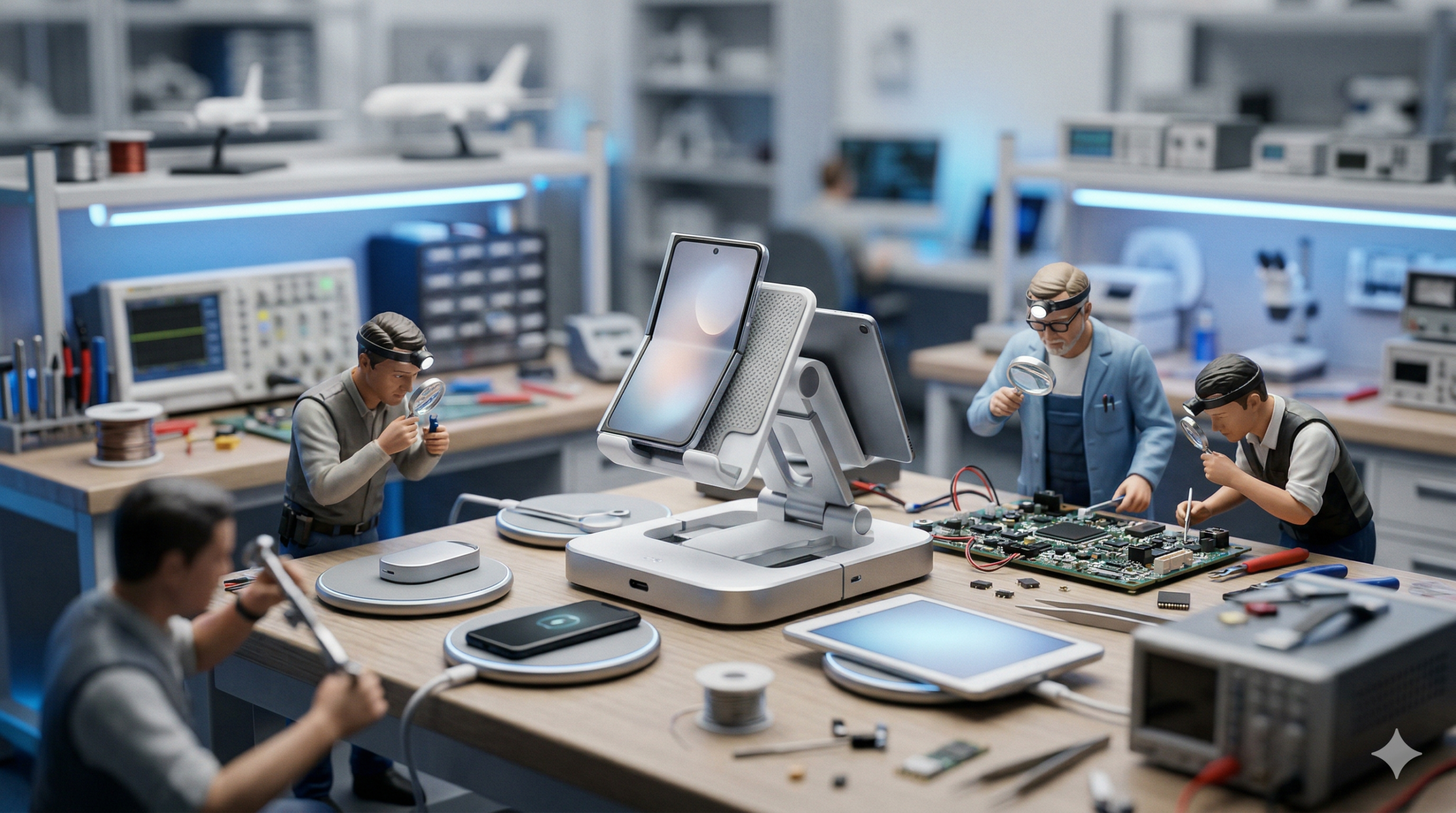
Apple has obtained a patent for foldable and rigid multi-device docking stations incorporating wireless alignment mechanisms, marking a strategic expansion of the company’s charging ecosystem infrastructure.
The newly granted patent, disclosed through the US Patent and Trademark Office, describes a sophisticated approach to simultaneous charging of multiple Apple devices. The invention addresses a critical challenge in multi-device households: how to charge phones, tablets, and wearables efficiently while maintaining proper alignment for wireless power transfer. Apple’s approach combines both foldable and rigid structural elements, allowing the dock to adapt to different device configurations and usage scenarios.
Technical Innovation and Claims Structure
At the heart of this patent lies Apple’s multi-position docking mechanism with integrated wireless power alignment. The claims specify articulated mounting arms capable of repositioning while maintaining precise coil alignment beneath the device contact surfaces. The patent distinguishes itself from prior art by incorporating force-feedback mechanisms that guide devices into optimal charging positions without requiring user intervention.
The technical specifications suggest compatibility with multiple device form factors simultaneously. Rather than designing separate docks for iPhone, iPad, and Apple Watch, this unified approach allows a single dock to serve the entire ecosystem. The wireless alignment system appears to use inductive coupling optimization—a technique where the dock’s coil array adjusts orientation to maximize power transfer efficiency regardless of device placement.
This represents a departure from Apple’s existing charging solutions, which typically prioritize single-device scenarios or require precise positioning. The patent’s claims suggest Apple recognizes the growing need for family-oriented charging solutions in multi-device households, where ecosystem lock-in extends to complementary hardware.
Strategic Context Within Apple’s IP Portfolio
This patent announcement arrives as Apple continues its aggressive expansion into proprietary charging infrastructure. Over the past five years, Apple has filed hundreds of patents covering charging technologies, wireless power, and device integration systems. The company’s broader strategy appears to emphasize vertical integration—controlling not just the devices but the complete ecosystem surrounding power delivery and device interaction.
The foldable docking station concept also aligns with Apple’s ongoing exploration of flexible form factors. While the company has been notably cautious about foldable smartphones compared to competitors like Samsung and Huawei, its patent filings suggest serious research into flexible display technology and collapsible form factors for future products. This docking station patent could serve as foundational IP for supporting such future devices.
Apple’s approach to accessory patents differs markedly from core device patents. Where the company pursues aggressive enforcement of smartphone and tablet patents, accessory patents often serve primarily as blocking positions—preventing competitors from developing functionally similar solutions while maintaining Apple’s ecosystem advantage. The foldable docking station patent likely serves dual purposes: enabling future Apple products while preventing third-party manufacturers from creating Apple-compatible multi-device charging solutions.
Competitive Positioning and Market Implications
The patent’s timing reflects competitive pressure from both dedicated accessory manufacturers and device makers with proprietary charging ecosystems. Samsung, for example, has introduced multi-device charging pads for its Galaxy ecosystem, while Chinese manufacturers offer low-cost variants. Apple’s patent protection suggests the company views premium multi-device charging as a strategic accessory category deserving differentiated technology and protected features.
The wireless alignment mechanism represents the true innovation threshold. Most existing multi-device docks rely on fixed coil positioning and require users to place devices in predetermined locations. Apple’s articulated approach with feedback mechanisms could enable more intuitive, user-friendly charging experiences—a significant advantage in the premium accessory market where design and usability command price premiums.
For third-party manufacturers, this patent narrows the design space available for Apple-compatible charging solutions. While independent makers can continue producing basic multi-device chargers, they cannot replicate the specific mechanical and electromagnetic innovations protected by this patent. This likely ensures Apple maintains control over premium multi-device charging experiences within its ecosystem.
Future Applications and Product Roadmap Signals
The patent’s specific claim language provides clues about Apple’s product development timeline. The inclusion of flexible mounting mechanisms suggests Apple anticipates devices with variable form factors—potentially flexible displays or rollable screens in later product generations. The wireless power alignment system appears designed to accommodate devices at multiple angles and orientations, hinting at landscape and portrait operation modes Apple may be preparing for future tablet or laptop accessories.
Beyond the immediate accessory application, the underlying technology could extend to Apple’s broader smart home strategy. If Apple develops AR/VR headsets or other wearable form factors requiring wireless charging, this patent provides essential IP infrastructure for multi-device charging scenarios in those domains.
The patent also signals Apple’s continued investment in proprietary wireless standards. Rather than adopting industry-standard Qi wireless charging approaches, Apple’s specific implementation suggests the company values differentiation and ecosystem control over interoperability. This positioning has proven lucrative historically, as users invest in Apple-specific accessories that reinforce ecosystem stickiness.
Implications for IP Strategy in Accessory Markets
This patent demonstrates how Apple leverages patent protection to monetize accessory categories beyond direct hardware sales. By securing fundamental claims covering multi-device wireless charging with articulated alignment, Apple creates licensing opportunities should the company choose to permit third-party manufacturing under license agreements. Alternatively, the patent serves as defensive IP, blocking competitors from free-design alternatives.
The decision to seek patent protection for a docking station—an accessory category many would consider mature and undifferentiated—reflects Apple’s comprehensive approach to IP strategy. Every product category receives systematic patent coverage, ensuring Apple maintains both offensive and defensive positions throughout its entire product ecosystem.
As wireless charging becomes increasingly ubiquitous across consumer electronics, patents covering specific implementation approaches gain importance. This patent protects not the concept of wireless charging itself (well-established prior art) but rather Apple’s specific innovations in multi-device scenarios, alignment mechanisms, and ecosystem integration. This precision in patent scope demonstrates how sophisticated IP management focuses protection on genuine technical differentiation rather than broad concept patents.
The foldable docking station patent will likely face no immediate enforcement challenges, as few competitors have simultaneously developed compatible alternative approaches. However, as multi-device charging becomes a standard expectation across smartphone ecosystems, this patent could become strategically important in preventing Samsung, Google, and other ecosystem competitors from offering fully Apple-compatible solutions. For Apple users and accessory buyers, the patent’s significance lies primarily in ensuring premium, integrated charging experiences remain exclusive to official Apple products—a pattern that has consistently defined Apple’s accessory business model.
この記事について
パテント探偵社 編集部
知的財産の世界で起きている出来事を、ジャーナリズムの手法で報道・分析する独立メディア。特許番号・法的根拠・当事者名を正確に記述しながら、専門家以外にも読みやすい記事を届けています。掲載内容は法的アドバイスではありません。