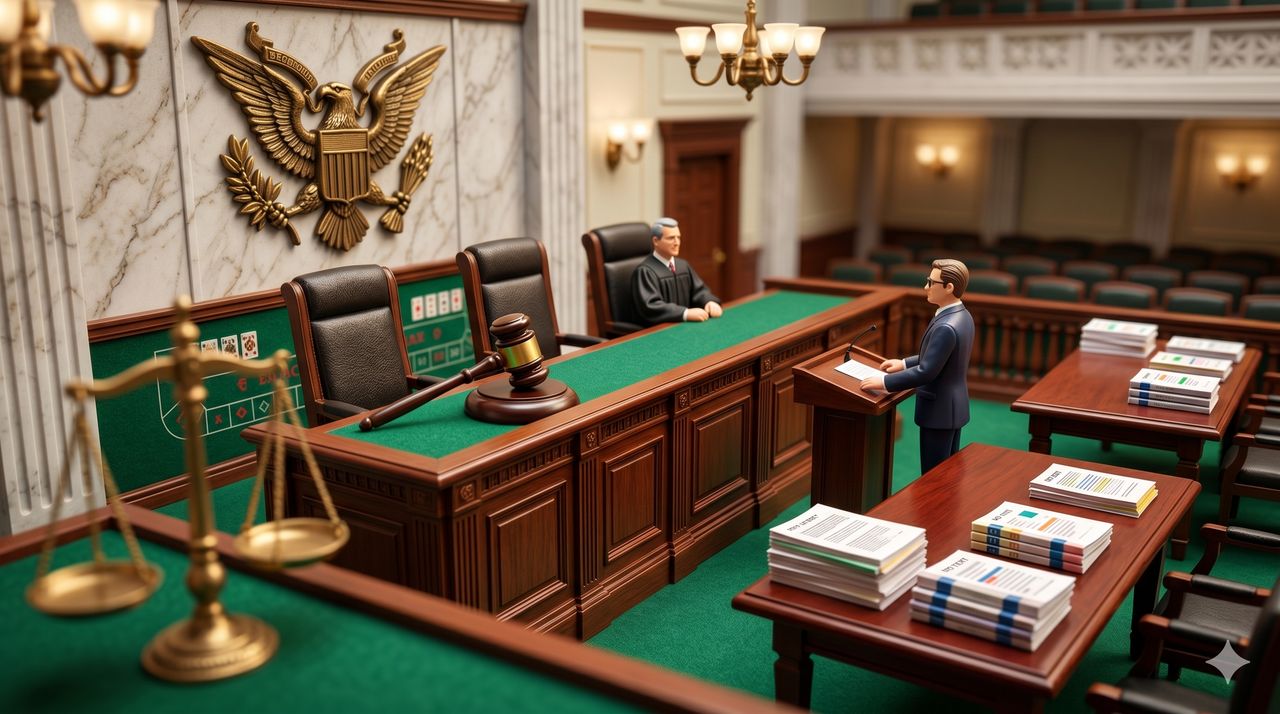
The U.S. Court of Appeals for the Federal Circuit (CAFC) on May 6, 2026, issued its decision in DK Crown Holdings Inc. v. AG 18, LLC (No. 24-2078), affirming a Patent Trial and Appeal Board (PTAB) final written decision and holding that DK Crown Holdings—formerly known as DraftKings, Inc.—failed to prove that claim 18 of AG 18’s U.S. Patent No. 9,978,205 was unpatentable. The ruling cements, on appeal, the validity of the only claim from AG 18’s ‘205 patent that survived the inter partes review (IPR).
Five Patents Challenged, One Claim Survived
AG 18, LLC, doing business as Arrow Gaming, owns a portfolio of five patents on networked gaming technology. The ‘205 patent at issue, titled “Location Based Restrictions on Networked Gaming,” covers peer-to-peer gaming systems that restrict a player’s online wagering activity based on geographic location.
After AG 18 sued DraftKings in August 2018 for infringing the portfolio, DraftKings petitioned the PTAB for IPR of all five patents. The district court stayed the litigation pending those reviews. In IPR2022-01447—the proceeding underlying this appeal—the PTAB found claims 1 through 17 and 19 through 30 of the ‘205 patent unpatentable as anticipated or obvious over the asserted prior art, but it confirmed the patentability of claim 18.
Late-Raised Ground 3 Argument Rejected
Claim 18 is a multiple-dependent claim that depends from independent claim 12 through dependent claims 15, 16, and 17. It is directed to a gaming system in which wagering limits convert to non-monetary wagering and any player winnings are similarly non-monetary.
In its IPR petition, DraftKings challenged claim 18 only under Grounds 1 and 2, both of which relied solely on Bryson (U.S. Patent No. 8,460,109) as the prior art reference. Ground 3—a Bryson-plus-Schlottmann combination—was directed in the petition exclusively at claims 15 through 17.
After the PTAB instituted review, DraftKings included a footnote in its petitioner’s reply requesting that the Board analyze claim 18 under Ground 3 rather than Grounds 1 and 2. The PTAB declined, finding that DraftKings was improperly attempting to introduce Schlottmann as a new prior art reference against claim 18 to fill a gap in the original petition. Because claims 15 through 17 are necessarily incorporated as limitations of claim 18, and because the original petition never argued that Bryson alone taught those limitations as applied to claim 18, the Board found that DraftKings had not carried its burden of proof.
CAFC Rejects “Clerical Error” Framing
On appeal, DraftKings argued that the Board “abused its discretion” by refusing to analyze claim 18 under Ground 3. The company characterized the omission as a “clerical error” and contended that its intent to apply Ground 3 to claim 18 was “obvious.”
The opinion, authored by Judge Chen, rejected those arguments. The CAFC stated that it “agreed with the Board that DK asserted a new ground of unpatentability in its Reply footnote against claim 18 by seeking to add Schlottmann to its challenge.” The court emphasized that its case law prohibits the Board from entertaining theories that were absent from the petition, and that the late-raised footnote “did not respond to any argument in [the] patent owner response.” DraftKings also did not move to amend its petition to correct the asserted oversight.
DraftKings further invoked Voice Tech Corporation v. Unified Patents, LLC, in which a typographical error in a petition was excused because the substantive argument was identifiable through cross-reference. The CAFC found Voice Tech inapplicable, concluding that DraftKings’ petition contained “no cross-reference or indication anywhere” that Ground 3 or Schlottmann was intended to apply to claim 18.
Collateral Estoppel Argument Also Fails
DraftKings additionally argued that claim 18 should be deemed unpatentable under collateral estoppel because the PTAB had already invalidated claims 10, 12, 15, 16, and 17, which together contain all of the limitations found in claim 18.
The CAFC rejected this theory outright. Relying on Ohio Willow Wood Co. v. Alps South, the court found that DraftKings had not satisfied the burden required to invoke collateral estoppel based on similarity to an already-invalidated claim. The court further noted that it had “never applied collateral estoppel in the manner DK suggests”—that is, by “cobbling together” limitations from disparate claims to replicate another claim—and saw no persuasive reason to do so for the first time here.
Practical Implications
The decision reinforces the rule that IPR petitioners must articulate their grounds of unpatentability completely and accurately at the petition stage. New prior art references cannot be introduced in a reply, and even framing the omission as a “clerical error” does not unlock a remedy. The CAFC has now reaffirmed that principle in a precedential posture for petitioners and their counsel.
The collateral estoppel ruling is equally notable. The court drew a clear line against using a patchwork of limitations drawn from previously invalidated claims to attack a separate claim that was never challenged on its own merits. For patent owners, the holding preserves the value of multiple-dependent claims as a litigation backstop when broader claims fall.
For AG 18, the affirmance keeps claim 18 alive and available as a basis for continued litigation against DraftKings in district court. As one commenter on IPWatchdog noted, DraftKings may now consider ex parte reexamination at the USPTO’s Central Reexamination Unit—a path that has gained renewed prominence as IPR institution rates contract under the agency’s settled-expectations framework. The online gaming and sports betting industry, expanding rapidly since the Supreme Court’s 2018 decision in Murphy v. NCAA, continues to generate significant patent litigation, of which this case is a prominent example.
この記事について
パテント探偵社 編集部
知的財産の世界で起きている出来事を、ジャーナリズムの手法で報道・分析する独立メディア。特許番号・法的根拠・当事者名を正確に記述しながら、専門家以外にも読みやすい記事を届けています。掲載内容は法的アドバイスではありません。


コメント