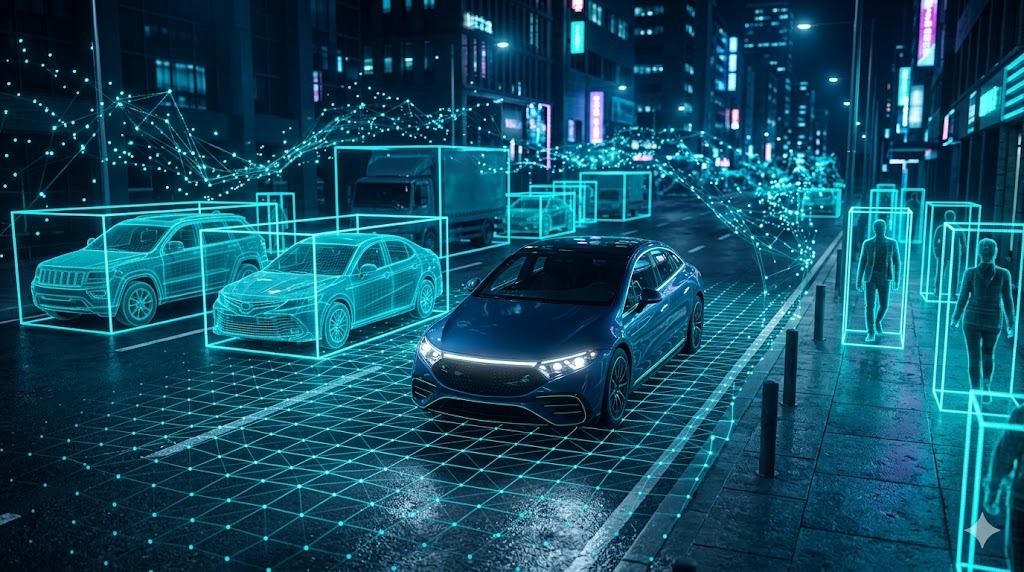
Tesla has released a patent covering AI-based occupancy data analysis methodologies for autonomous driving systems, advancing the company’s intellectual property position in machine perception and spatial reasoning technologies essential for self-driving vehicles.
Published on March 12, 2026, the patent details Tesla’s proprietary approach to processing occupancy grid data—a three-dimensional representation of vehicle surroundings that identifies obstacles, navigable space, and potential hazards. This patent represents a fundamental advancement in how Tesla’s autonomous systems interpret complex dynamic environments, translating raw sensor data into actionable spatial understanding necessary for safe vehicle operation.
Technical Architecture and Occupancy Grid Processing
The patent describes Tesla’s methodology for constructing and updating three-dimensional occupancy representations from multiple sensor inputs. Unlike simpler approaches that detect discrete objects, Tesla’s occupancy grid approach models environment space with granular cell-by-cell probability assessments, creating comprehensive spatial maps that capture both hard obstacles and soft predictions about likely vehicle positions or pedestrian trajectories.
The technical innovation centers on AI algorithms that fuse data from multiple sources—cameras, radar, ultrasonic sensors, and potentially LiDAR on certain Tesla variants—into coherent occupancy representations. The patent claims specify neural network architectures optimized for real-time processing, where computational efficiency enables continuous occupancy grid updates at autonomous vehicle decision-making rates (typically 10-100 Hz frequency).
Occupancy grid representations address a critical challenge in autonomous perception: uncertainty quantification. Raw sensor inputs contain inherent ambiguity—cameras provide high spatial resolution but struggle in poor lighting, radar penetrates obstacles but offers lower resolution, ultrasonic sensors detect nearby objects with limited range. Tesla’s approach combines these disparate sensor modalities through AI algorithms that learn optimal data fusion strategies, explicitly encoding confidence levels and uncertainty propagation throughout the spatial representation.
Competitive Differentiation in Autonomous Perception
Tesla’s occupancy-based approach contrasts with competitor methodologies in significant ways. Waymo has traditionally emphasized object-centric representations—identifying and tracking specific entities (vehicles, pedestrians, cyclists) with precise bounding boxes and trajectory predictions. Tesla’s occupancy grid approach emphasizes space rather than objects, creating continuous risk assessment across the vehicle’s operating domain.
This methodological choice reflects Tesla’s broader autonomy philosophy. With manufacturing access to millions of vehicles capable of continuous data collection, Tesla accumulates vast datasets of driving scenarios. Occupancy-based approaches benefit from this data abundance, as training occupancy grids requires less explicit labeling than object-centric methods. Rather than annotating thousands of bounding boxes in each training image, occupancy approaches use less labor-intensive labels (collision outcomes, driver interventions) to guide AI model development.
Tesla’s patent strategy emphasizes data-driven AI approaches over traditional sensor fusion architectures, reflecting the company’s competitive advantages in fleet data collection and deep learning expertise. This patent positions Tesla’s occupancy methodology as a distinctive technological approach within the autonomous vehicle landscape, differentiated from competitors pursuing object detection-based architectures.
Safety Critical Applications and Liability Implications
Occupancy data analysis carries profound safety implications in autonomous vehicle contexts. The accuracy and timeliness of environment understanding directly influence vehicle collision risks, pedestrian safety, and overall operational safety margins. Tesla’s patent documentation addresses robustness requirements by specifying AI architectures designed for high-confidence spatial representation even in challenging sensor conditions.
From liability perspective, Tesla’s published patent creates important documentation of the company’s occupancy analysis methodology. In potential accident litigation or regulatory proceedings, patent specifications provide explicit evidence of Tesla’s engineering approaches and design rationale. By publishing occupancy grid patents, Tesla effectively documents its autonomous driving philosophy and technical implementation details for future legal proceedings where safety system design becomes central to liability determinations.
The patent also signals Tesla’s confidence in occupancy-based approaches as fundamentally sound for autonomous operation. Rather than treating occupancy methodology as proprietary trade secrets, publishing the patent indicates Tesla believes the company’s specific implementation (neural network architectures, real-time constraints, sensor fusion strategies) provides sufficient competitive advantage to warrant patent protection over trade secret protection.
Strategic Positioning Within Tesla’s Autonomy Roadmap
Tesla’s stated Full Self-Driving (FSD) program targets production fully autonomous vehicles without intervention by 2027-2028 timeframe. Occupancy data analysis represents a foundational perception capability necessary for achieving this roadmap milestone. By securing patent protection on occupancy methodologies now, Tesla establishes IP ownership for core FSD algorithms, preventing competitors from implementing identical approaches.
The patent publication also carries implications for Tesla’s software update strategy. As Tesla gradually enables higher levels of autonomy through over-the-air software updates to existing fleet vehicles, each incremental capability relies on underlying perception algorithms. Publishing occupancy patents documents Tesla’s technical foundation for these incremental autonomy releases, creating competitive barriers that prevent other autonomous platforms from rapidly replicating Tesla’s technical progression.
Regulatory and Standards Development Considerations
As autonomous vehicle regulation develops globally, patent-documented technologies increasingly influence regulatory acceptance. When regulatory bodies evaluate autonomous system safety, they examine engineering approaches and technical documentation. Patents provide formal technical documentation that demonstrates rigorous engineering methodology. Tesla’s occupancy grid patent effectively establishes published evidence of Tesla’s systematic approach to environment perception, potentially supporting Tesla’s regulatory arguments regarding Full Self-Driving safety credibility.
The patent also influences autonomous vehicle standards development. International standards organizations (ISO, SAE) developing autonomous vehicle safety requirements consider existing industry practices and published technical approaches. By publishing occupancy methodology patents, Tesla influences the trajectory of industry standards toward approaches compatible with Tesla’s technical architecture, creating advantages in regulatory alignment.
Licensing and Ecosystem Implications
Unlike accessory patents that companies might license to third parties, Tesla’s autonomous driving patents serve primarily defensive functions. The company has shown minimal interest in licensing FSD technology to competitors or enabling third-party autonomous vehicle platforms. Instead, Tesla accumulates autonomous patents to establish comprehensive IP coverage protecting Tesla’s proprietary autonomy stack from competitor replication.
However, the patent’s publication does create potential licensing negotiation points with component suppliers. Companies developing autonomous-capable sensors (camera, radar manufacturers) might seek licensing agreements acknowledging Tesla’s occupancy analysis methodology, preventing future patent disputes over sensor technology overlapping with Tesla’s claimed inventions.
The patent also carries implications for potential Tesla partnerships with traditional automotive manufacturers evaluating autonomous capabilities. If Tesla eventually licenses autonomy technology to legacy OEMs (unlikely near-term but strategically possible), occupancy patents would constitute core IP assets subject to licensing agreements, creating ongoing revenue streams from Tesla’s FSD development investments.
Future Autonomous Perception Evolution
Tesla’s occupancy patent represents current-generation autonomous perception methodology. As autonomous systems evolve toward Level 4-5 autonomy (fully autonomous without human intervention), perception algorithm sophistication will necessarily increase. Future patents will likely describe hybrid approaches combining occupancy representations with object-centric tracking, temporal prediction models, and semantic scene understanding—building on foundational occupancy methodology that this patent documents.
Tesla’s comprehensive patent strategy in autonomous driving accumulates incrementally, with each published patent establishing IP territory that prevents competitors from developing identical technical approaches. As autonomous vehicle deployment accelerates globally, patent-protected perception algorithms will increasingly determine competitive positioning, with companies like Tesla—having invested years in FSD patent development—maintaining significant technological and legal advantages over late-entering competitors.
The occupancy analysis patent demonstrates Tesla’s commitment to systematic, documented technical development in autonomous systems. While Tesla’s Autopilot and Full Self-Driving capabilities remain proprietary to Tesla vehicles, the patent system ensures this competitive advantage persists for the patent’s full 20-year term, protecting Tesla’s substantial autonomy research investments from rapid competitive replication.
この記事について
パテント探偵社 編集部
知的財産の世界で起きている出来事を、ジャーナリズムの手法で報道・分析する独立メディア。特許番号・法的根拠・当事者名を正確に記述しながら、専門家以外にも読みやすい記事を届けています。掲載内容は法的アドバイスではありません。