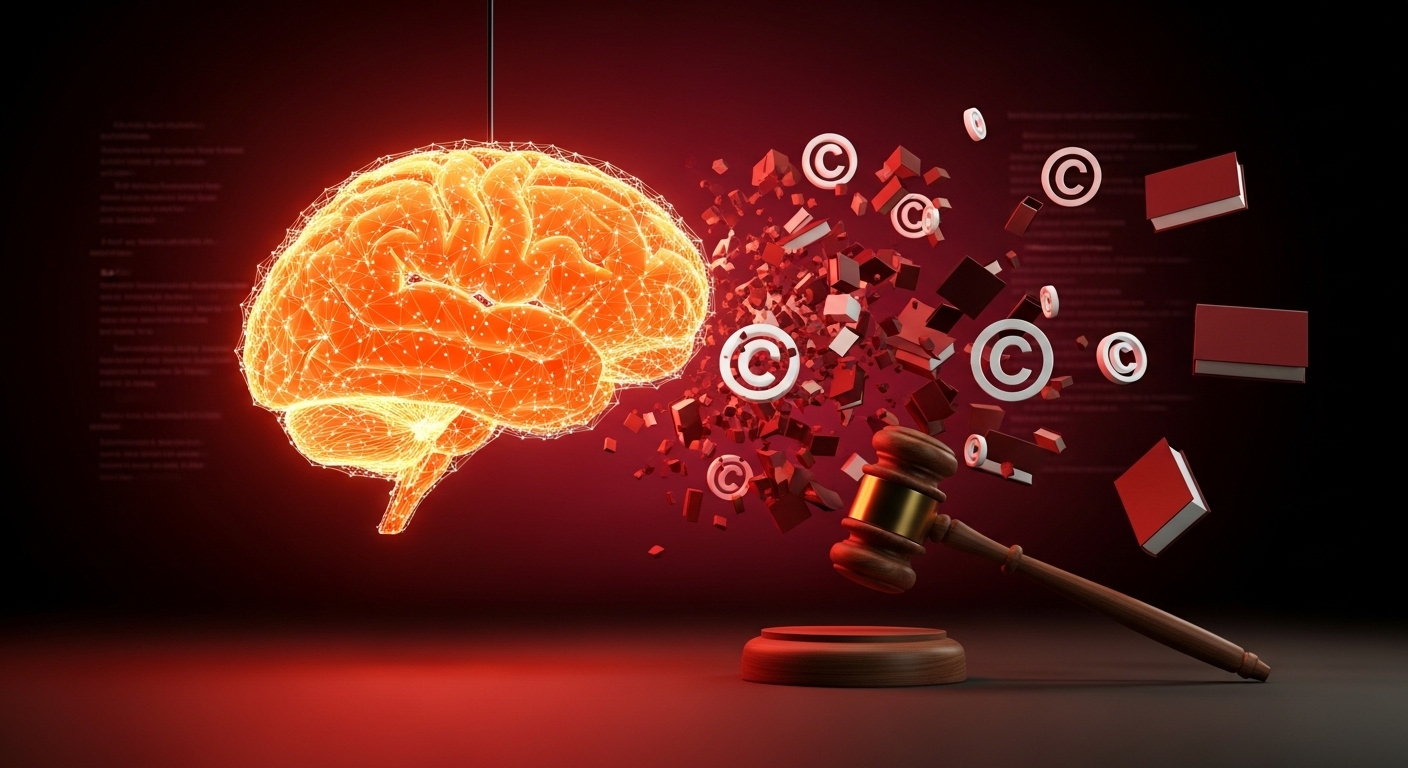
It was January 2026, and the AI industry was holding its collective breath. For months, Anthropic—the safety-focused AI startup backed by billions in venture capital—had been defending itself against a sweeping class action lawsuit brought by a coalition of authors, journalists, and publishers. The claim was straightforward but seismic: that Anthropic had trained its Claude large language models on copyrighted works without permission, authorization, or payment.
Then, quietly but with enormous reverberations, came the announcement: Anthropic had agreed to settle for approximately $1.5 billion. No admission of liability. No court order forcing changes to training practices. But a sum of money large enough to rewrite the calculus for every AI company building foundation models on the internet’s vast corpus of human-generated text.
Welcome, fellow Patent Detectives, to what may be the most consequential copyright settlement since the music industry’s Napster wars of the early 2000s. Let’s put on our investigator’s hats and figure out what happened, why it matters, and where AI copyright law goes from here.
- The Complaint: Authors Strike Back Against the Machine
- The Legal Battlefield: Fair Use in the Age of Machine Learning
- The Memorization Problem: When AI Becomes a Copy Machine
- Why .5 Billion? The Settlement Math
- The Distribution Question: Who Gets What?
- Structural Relief: The Non-Monetary Terms
- Parallel Litigation: The Broader AI Copyright Ecosystem
- International Dimensions: How Other Jurisdictions Are Approaching AI Copyright
- What Does This Mean for the AI Industry? The Detective’s Analysis
- The Japanese Creative Industry Perspective
- The Authors’ Perspective: Justice Delayed, Justice Complicated
- The Road Ahead: Where Does AI Copyright Law Go From Here?
- Conclusion: A New Chapter in Copyright History
The Complaint: Authors Strike Back Against the Machine
The lawsuit that eventually led to the $1.5 billion settlement was not the first of its kind, but it became the largest and most significant. Filed as a class action in federal court in late 2023 and consolidated through 2024, it alleged that Anthropic’s training pipeline for Claude systematically ingested copyrighted books, articles, academic papers, and journalistic work—all without obtaining licenses, paying royalties, or even informing the creators whose work had been consumed.
The plaintiffs included novelists, non-fiction authors, and journalists whose work appeared in widely-distributed datasets like “The Pile” and “Books3″—enormous text collections assembled by scraping the internet that were known to contain copyrighted material. Their argument rested on a foundational IP principle: the reproduction of a copyrighted work, even for the purpose of “learning” from it, constitutes copyright infringement unless a valid exception like fair use applies.
Anthropic’s defense centered on fair use. Its lawyers argued that training an AI on text is transformative—the model doesn’t memorize or reproduce the books; it extracts statistical patterns that allow it to generate new text. No consumer of Claude would ever read a verbatim copy of a plaintiff’s novel. The training process, Anthropic argued, is more like a human reading a book and gaining knowledge than like a copier running a book through its scanners.
This tension—between the authors’ reproduction argument and Anthropic’s transformative use argument—sat at the heart of the case. And it was a genuinely hard legal question.
The Legal Battlefield: Fair Use in the Age of Machine Learning
To understand why this case mattered so much, we need to understand the four-factor fair use test that governs copyright exceptions in the United States under 17 U.S.C. § 107. Courts must consider:
1. The purpose and character of the use — Is it commercial? Is it transformative? A use that adds new meaning, expression, or message is more likely to qualify as fair use. AI training, its proponents argued, is maximally transformative: the copyrighted text is not the output; the model’s weights are.
2. The nature of the copyrighted work — Creative works (novels, poetry) receive stronger protection than factual works (news articles, databases). The plaintiffs’ works were largely creative, which weighed against fair use.
3. The amount and substantiality of the portion used — AI training often ingests entire works, not just excerpts. This factor seemed to favor the plaintiffs heavily. How can copying a book in its entirety be fair use?
4. The effect on the potential market for the original work — This is often the most important factor. If AI-generated content substitutes for the original works—if people use Claude to get a summary of a book instead of buying it—that could devastate the market for those works. But the question was fiercely disputed.
The precedent landscape was treacherous for both sides. In Authors Guild v. Google (2d Cir. 2015), the court held that Google’s creation of a searchable index of books via scanning was transformative fair use, even though Google had copied millions of complete works. But Google’s search snippets were different from a conversational AI that could potentially reproduce substantial portions of text on demand.
In the music sampling context, courts have sometimes drawn a line at complete reproduction. In Grand Upright Music Ltd v. Warner Communications (S.D.N.Y. 1991), Judge Kevin Duffy famously declared “Thou shalt not steal” in ruling against unlicensed sampling. The AI training context is different—but the principle of obtaining permission before commercially exploiting others’ creative work has deep roots in copyright jurisprudence.
The Memorization Problem: When AI Becomes a Copy Machine
One of the most damaging pieces of evidence plaintiffs in various AI copyright cases have surfaced is the memorization problem. Researchers at Google and elsewhere have demonstrated that large language models can, under certain prompting conditions, reproduce verbatim text from their training data. In some experiments, GPT-4 and similar models regurgitated substantial passages from copyrighted books when prompted in specific ways.
This directly undercut the “transformative” defense. If the model can reproduce the original work—even occasionally, even with prompting tricks—then the training process is not purely extracting abstract patterns. Some of the original expression is being encoded and stored, ready to be reproduced. For copyright law, which protects expression rather than ideas, this is a critical distinction.
The expert witnesses in the Anthropic case debated this fiercely. AI researchers testified that memorization is a marginal byproduct of training on large corpora and that the primary function of the model is generative, not reproductive. Copyright scholars countered that the capacity for reproduction is legally relevant—that building a system capable of reproducing copyrighted text without authorization implicates reproduction rights, regardless of how often that capacity is actually triggered.
Why .5 Billion? The Settlement Math
Settlements are, by definition, compromises. Neither side gets everything it wants. So what drove the parties to this extraordinary number?
Consider the exposure. The Copyright Act allows statutory damages of $750 to $150,000 per work infringed—and the “willful” infringement end of that range applies when the infringer knew or should have known they were infringing. The class covered thousands of authors. Even at $750 per work, with millions of works potentially at issue, the theoretical maximum damages were astronomical—far exceeding even $1.5 billion.
But defendants also had real defenses. Fair use is a genuine legal doctrine with case support. The transformative nature of AI training, while contested, is not a frivolous argument. In Kelly v. Arriba Soft Corp. (9th Cir. 2003), the court held that using thumbnail images to generate search results was transformative fair use. In Perfect 10, Inc. v. Amazon.com, Inc. (9th Cir. 2007), the court extended similar reasoning to Google Image Search. There was a real chance the defendants might have prevailed at trial.
The $1.5 billion figure reflects a blended expected value: the probability of plaintiffs prevailing multiplied by the magnitude of potential damages, discounted for litigation risk, and adjusted for the urgency both sides had to resolve the uncertainty. Anthropic needed certainty to continue raising capital and operating its business. The plaintiffs’ lawyers needed a win that would justify years of complex litigation. $1.5 billion—to be distributed among class members—was the answer they reached.
For context: this dwarfs the Google Books settlement, which was rejected by a federal judge in 2011 at approximately $125 million. It exceeds the total recorded music industry settlements against Napster, Kazaa, and similar peer-to-peer networks. It is, by any measure, the largest copyright settlement in the history of AI.
The Distribution Question: Who Gets What?
A $1.5 billion class action settlement immediately raises a practical question: how does that money get to individual authors? The mechanics of distributing settlement proceeds in a creative works class action are extraordinarily complex.
The settlement likely established an administrative claims process under which class members—authors and publishers whose works were included in Anthropic’s training data—could submit claims. Each claim would require demonstrating: (1) ownership of the copyright at the time of training; (2) inclusion in the relevant training datasets; and (3) injury (typically presumed for statutory damages purposes).
The datasets in question—including various versions of “The Pile,” “Books3,” and web crawls—have known compositions that have been publicly studied by AI safety researchers. Matching works in those datasets to copyright owners is technically feasible, though labor-intensive. Claims administrators in similar cases have used a combination of automated matching and manual verification.
The practical reality is that headline settlement figures rarely translate 1:1 into checks for individual claimants. Attorney fees (typically 25-33% of a class action settlement), administrative costs, and the sheer number of claimants mean that individual payouts may be modest. A novelist whose three books were included in the training data might receive a few thousand dollars—significant symbolically, but perhaps not life-changing economically.
Structural Relief: The Non-Monetary Terms
As important as the money is what else the settlement required. In major IP settlements, structural relief—changes to business practices—often matters more in the long run than cash payments. The specific terms of the Anthropic settlement were filed under seal in some respects, but industry reporting and court filings indicated several non-monetary components.
These reportedly included provisions around opt-out mechanisms for future training runs, enhanced content filtering to reduce verbatim reproduction, and a commitment to develop and maintain a licensing program through which rights holders could receive compensation for their works’ inclusion in future training datasets. Whether these structural provisions have teeth—and whether they will be enforced—will be a matter of monitoring over the coming years.
The licensing program component is particularly significant. It suggests a potential path toward a market-based solution: rather than treating AI training as either clearly infringing (requiring permission each time) or clearly fair use (requiring no permission), a licensing regime could create a middle ground where AI developers pay a rate to include copyrighted works and rights holders can choose to participate or opt out.
Parallel Litigation: The Broader AI Copyright Ecosystem
The Anthropic settlement did not exist in a vacuum. By early 2026, the AI copyright litigation landscape was extraordinarily crowded:
Getty Images v. Stability AI (filed 2023) remained ongoing in multiple jurisdictions, with Getty claiming that Stability AI had ingested over 12 million Getty photos—complete with watermarks—to train its Stable Diffusion image generation model. The watermark evidence was particularly compelling: AI-generated images had, in some cases, incorporated Getty’s watermark as a visual artifact, suggesting direct copying rather than abstract pattern extraction.
The New York Times v. Microsoft and OpenAI (filed December 2023) was proceeding toward trial, with the Times offering striking examples of ChatGPT reproducing near-verbatim passages from Times articles when prompted appropriately. Microsoft and OpenAI were contesting these examples as edge cases, arguing they demonstrated bugs in the system rather than the system’s fundamental design.
Authors Guild v. OpenAI had been consolidated with dozens of individual author suits, creating a class that potentially encompassed thousands of published authors. Sarah Silverman, George R.R. Martin, John Grisham, and Jodi Picoult were among the named plaintiffs—names calculated to maximize public sympathy and media attention.
Concord Music Group v. Anthropic specifically addressed song lyrics, arguing that Claude could reproduce copyrighted lyrics when asked for songs. This vertical—music lyrics—has historically received very strong copyright protection. The Copyright Office requires registration for musical works, and the music industry has decades of experience aggressively enforcing lyric rights.
The Anthropic $1.5 billion settlement will inevitably affect all of these cases. It establishes a data point: a major AI company, when faced with a serious class action with thousands of class members, settled for this amount. Plaintiffs in other cases will use it as a floor; defendants will try to distinguish it. It will not end the litigation, but it will reshape its contours.
International Dimensions: How Other Jurisdictions Are Approaching AI Copyright
While the American litigation drama was unfolding, courts and legislatures around the world were wrestling with the same fundamental question: does training an AI on copyrighted material require a license?
The European Union had taken a legislative approach. The EU AI Act, passed in 2024, required AI system providers to publish “sufficiently detailed summaries” of the training data used, including which copyrighted materials were included. The EU Copyright Directive (2019) included a text and data mining (TDM) exception that allowed research organizations to mine copyrighted text without a license—but the commercial AI industry did not clearly qualify for this exception. The “opt-out” mechanism in Article 4 of the Directive allowed rights holders to reserve their rights against commercial TDM, and some publishers had done exactly that.
The United Kingdom had a long-running policy debate about whether to create a broad TDM exception similar to Japan’s, with the UK government at various points proposing to allow AI training on any lawfully accessed material. Strong opposition from the creative industries caused repeated retreats and revisions. The legal landscape in the UK remained uncertain through early 2026.
Japan offered the most permissive framework. Japan’s 2018 amendment to the Copyright Act created an extremely broad exception for “information analysis” (情報解析), allowing AI training on copyrighted works without permission or payment—even for commercial purposes. This made Japan uniquely attractive as a jurisdiction for AI training activities, and several companies structured their training operations to take advantage of this exception. The Japanese creative industry had pushed back, but legislative change was slow.
China took yet another approach: requiring AI developers to obtain licenses for training data, at least for training data sourced from Chinese works, under its Generative AI Regulation (生成式人工智能服务管理暂行办法, 2023). Chinese AI developers like Baidu and ByteDance had scrambled to establish compliant training pipelines.
What Does This Mean for the AI Industry? The Detective’s Analysis
Let me put on my analytical hat and work through the implications of the Anthropic settlement for the AI industry as a whole.
The cost of AI development just got more expensive. If $1.5 billion is the going rate for a class action settlement over training data, then AI developers need to factor this into their cost models. Either they pay licensing fees upfront (which may be preferable, since you can control the cost), or they risk settling at extraordinary cost after the fact. For startups with limited capital, this is an existential consideration.
Licensing markets will develop. The settlement’s structural provisions around licensing point toward a future where AI training data is a licensed product, not a public good. Several entities—including the Copyright Clearance Center, the Authors Guild, and various news industry consortia—had already begun developing licensing frameworks for AI training. The settlement gives these frameworks urgency and legitimacy.
Training data provenance will become a competitive moat. Companies that can demonstrate they trained exclusively on licensed data—or data that clearly qualifies for a legal exception—will have a significant advantage in regulated markets and with enterprise customers who need legal certainty. “Clean data” provenance will become a selling point.
Smaller AI developers face existential risk. A $1.5 billion settlement is survivable for a well-capitalized company like Anthropic. For a startup with $50 million in funding, it would be terminal. This creates pressure toward consolidation—only large, well-funded companies can bear the copyright litigation risk of training foundation models on web-scale data.
The fair use question remains unresolved. Because the case settled rather than going to judgment, there is no binding legal precedent about whether AI training constitutes fair use. Every other AI company faces the same legal uncertainty that Anthropic faced. The question will be litigated again—probably in the New York Times case or the Getty Images case—until a court renders a definitive ruling.
The Japanese Creative Industry Perspective
Japan occupies a peculiar position in the global AI copyright debate. On one hand, Japan’s permissive “information analysis” copyright exception has made it a haven for AI training activities. On the other hand, Japanese creative industries—manga artists, light novel authors, game designers—have been vocal about their concerns regarding AI-generated content that imitates their styles without compensation.
The manga and anime industry in particular has organized through groups like the “AI to Chosakuken wo Kangaeru Kai” (会 — the Society for Considering AI and Copyright) to lobby for changes to Japan’s permissive framework. Individual artists have reported seeing AI models trained on their distinctive styles producing outputs indistinguishable from their own work—without any form of attribution or compensation.
The Anthropic settlement will inevitably enter Japanese policy discussions. If American AI companies face billion-dollar liability for training on copyrighted works, the argument that Japan’s exception is appropriately calibrated becomes harder to maintain. Whether Japanese lawmakers will respond—and how—is one of the most interesting IP policy questions of the coming years.
There’s also a global competitiveness dimension. Japanese AI companies operating under Japan’s permissive rules compete with American companies that may now face higher compliance costs. This creates a regulatory arbitrage: companies might route training operations through jurisdictions with permissive rules. How international IP frameworks respond to this pressure will shape the geography of AI development.
The Authors’ Perspective: Justice Delayed, Justice Complicated
From the perspective of the individual authors who brought the case, the settlement is complicated. $1.5 billion sounds enormous. But divided among thousands of class members, minus attorney fees and administrative costs, individual payments may be far more modest than the headline figure suggests.
More fundamentally, many author-plaintiffs were motivated not primarily by money but by principle: the desire for acknowledgment that their work has value, that it cannot be taken without permission, and that AI companies must operate within the same legal framework as everyone else. A settlement without an admission of liability provides none of that principled satisfaction. Anthropic can truthfully say it settled for business reasons while maintaining that its training practices were lawful.
Some authors in the class action objected to the settlement terms, arguing that the structural relief was insufficient—that without meaningful restrictions on future training practices, the settlement simply allowed Anthropic to pay a one-time toll and continue as before. The adequacy of the settlement, and whether class members are treated fairly, will be tested at the fairness hearing before the district court.
There’s also the question of what happens to authors whose work is included in future training runs—works created after the class period covered by this settlement. The settlement resolves past liability. It does not necessarily prevent future infringement of future works. Absent ongoing licensing arrangements or legislative change, the underlying legal uncertainty persists.
The Road Ahead: Where Does AI Copyright Law Go From Here?
As our investigation concludes, let’s look at the map ahead. Several scenarios seem plausible.
Scenario 1: The Licensing Ecosystem Emerges. Driven by the Anthropic settlement and related litigation, a robust licensing market develops. Content licensing entities negotiate standard rates for AI training data. AI developers pay these rates and receive “clean data” certification. Rights holders receive ongoing royalties. This is the music industry ASCAP/BMI model applied to text. It is economically rational but requires coordination among many competing interests.
Scenario 2: Legislative Resolution. Congress passes an AI Copyright Act that creates a statutory license for AI training—similar to the mechanical license for music recordings under 17 U.S.C. § 115—with defined rates, opt-out mechanisms, and a collecting society to administer payments. Several members of Congress had introduced bills along these lines by early 2026, though none had advanced to floor votes.
Scenario 3: Court Finds Fair Use. In the New York Times case or another litigation, a court issues a definitive ruling that AI training on publicly available copyrighted material constitutes fair use. This would relieve AI companies of the licensing burden but would leave rights holders with no compensation mechanism. The Supreme Court might ultimately need to resolve the question.
Scenario 4: Fragmented Uncertainty. Different courts reach different conclusions; some countries create licensing requirements while others maintain permissive exceptions; AI companies navigate a patchwork of national and regional requirements. This is the least efficient outcome but perhaps the most likely near-term reality.
Whichever scenario unfolds, the Anthropic $1.5 billion settlement has established an indelible marker. It says: the stakes are real, the risk is material, and the creative community will fight. For AI developers, rights holders, policymakers, and—yes—Patent Detectives, the case has only just begun.
Conclusion: A New Chapter in Copyright History
Every generation has its copyright watershed moment. The 1970s brought the photocopying debates and the landmark Williams & Wilkins Co. v. United States case. The 1990s brought the internet and the Digital Millennium Copyright Act. The 2000s brought peer-to-peer networks and billion-dollar settlements with the music industry. The 2010s brought the streaming wars and the transformation of creative industry business models.
The 2020s are bringing artificial intelligence—and with it, questions about copyright that the Framers of the Constitution could not have imagined when they granted Congress the power to “promote the Progress of Science and useful Arts.” What does “exclusive right” mean when a machine can learn from a work without reproducing it in any traditional sense? What does “copying” mean when the copy is encoded in billions of floating-point numbers rather than printed pages? What does “fair use” mean when the user is not human?
Anthropic’s $1.5 billion settlement does not answer these questions. But it tells us, beyond any doubt, that they are worth asking—and that the answers will cost billions to determine. For the authors whose words trained the machines, for the companies whose fortunes depend on those machines, and for the legal system tasked with making sense of it all, the investigation continues.
will be watching.
この記事について
パテント探偵社 編集部
知的財産の世界で起きている出来事を、ジャーナリズムの手法で報道・分析する独立メディア。特許番号・法的根拠・当事者名を正確に記述しながら、専門家以外にも読みやすい記事を届けています。掲載内容は法的アドバイスではありません。