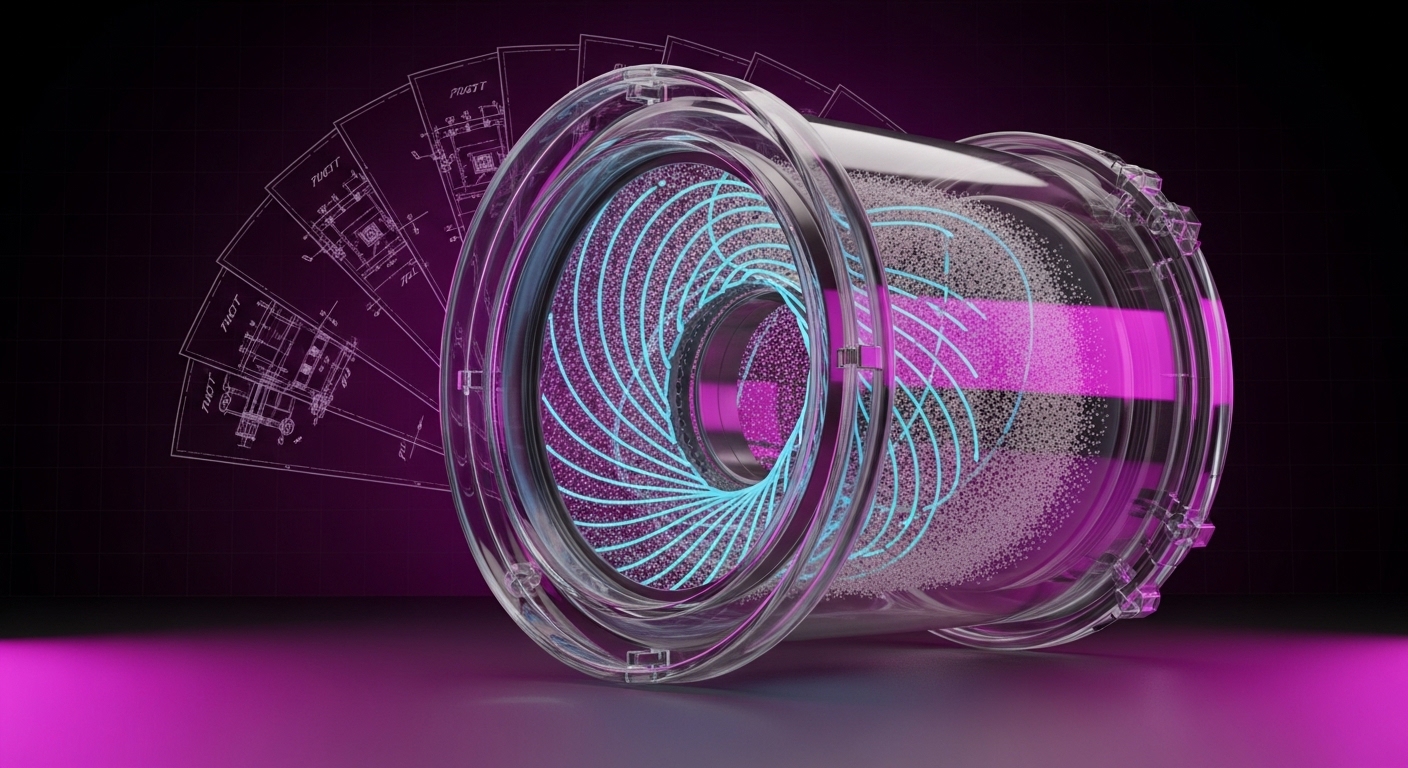
What happens when an inventor refuses to take “no” for an answer 5,127 times? You get the Dyson story — one of the most remarkable examples of how systematic patent strategy can protect a revolutionary idea and build a multi-billion dollar business. James Dyson’s journey from a frustrated vacuum cleaner user to the head of a global engineering empire offers lessons that apply to any entrepreneur, startup founder, or product innovator thinking about intellectual property.
The Problem That Launched a Patent Empire
The story begins in 1978 with a simple observation: vacuum cleaners lose suction. James Dyson noticed that his household vacuum’s performance degraded as the bag filled up. Dust and debris clogged the filter, reducing airflow and suction power. As an industrial designer, Dyson was bothered by this in a way that went beyond mere inconvenience — he saw it as a fundamental engineering failure that should have a technical solution.
Dyson found his inspiration in an industrial setting: a sawmill using a cyclone separator to remove sawdust from the air. The principle was elegant — air was spun at high speed, and centrifugal force pulled heavier particles (sawdust, in the factory’s case; dust and debris in a vacuum) to the outer walls of the separator, where they fell away from the clean airflow. No bag. No filter getting clogged. No suction loss.
What followed was five years of relentless iteration. Between 1978 and 1983, Dyson built 5,127 prototypes, each one incrementally different from the last. This number isn’t just a compelling anecdote — it reflects a systematic engineering methodology that also has important implications for patent strategy. Each prototype represented a documented iteration. Each significant improvement represented a potentially patentable innovation. And each patentable innovation, properly protected, would become a piece of the patent portfolio that would eventually make Dyson’s business nearly impossible to duplicate.
The “Patent Wall” Strategy: Building a Thicket of Protection
Most people think about patents one at a time: you have an idea, you patent it, and you’re protected. Dyson’s approach is far more sophisticated — and far more effective. Rather than relying on a single foundational patent, Dyson built what intellectual property strategists call a “patent thicket”: a dense network of overlapping patents that makes it extremely difficult for competitors to develop competing products without infringing on at least some of them.
The cyclone vacuum technology alone is protected by hundreds of Dyson patents. These patents don’t just cover the basic principle of using centrifugal force to separate dust from air — they cover the specific geometry of the cyclone chamber, the angle of the air intake, the speed of the airflow, the method of compressing collected debris, the design of the dust bin, the filtration systems used to capture fine particles that escape the primary cyclone, the motor technology that powers the entire system, and even specific manufacturing processes. In other words, Dyson patented not just the idea but the entire implementation ecosystem.
Here’s why this matters strategically: even if a competitor can legally use the basic principle of cyclone separation (because basic scientific principles can’t be patented), they still can’t easily build a practical, sellable vacuum without running into Dyson’s patents on all the surrounding implementation details. You can’t just use cyclones — you need to control the airflow, manage the separated debris, prevent fine dust from escaping, and make the whole thing quiet enough and durable enough for household use. Dyson has patents on all of those sub-problems.
The strategy also includes what patent professionals call “continuation patents” and “improvement patents.” As Dyson continued to refine its products, it filed new patents covering the improvements. This means that even as early foundational patents expired, new patents protecting the latest technology kept the competitive moat intact. A competitor who waited for Dyson’s earliest patents to expire would find that the current products they wanted to copy were protected by entirely new generations of patents.
Dyson’s IP Litigation Record: Enforcing the Portfolio
A patent portfolio is only as valuable as your willingness and ability to enforce it. Many companies build impressive patent collections but never actually use them defensively, making them largely decorative. Dyson has been the opposite: the company has demonstrated a consistent pattern of aggressive enforcement that sends a clear message to potential infringers.
The most famous early enforcement action was against Hoover. When Hoover launched a cyclone vacuum cleaner called the “Triple Vortex,” Dyson sued for patent infringement. After litigation, Dyson prevailed and was awarded approximately £4 million in damages — significant both as a financial recovery and as a public demonstration that Dyson’s patents had real teeth. The Hoover case became a well-known precedent in the vacuum cleaner industry, signaling that any company thinking about developing cyclone technology needed to either license Dyson’s patents or be prepared for costly litigation.
Dyson has also pursued patent disputes with major Asian electronics manufacturers including Samsung and LG. These cases illustrate an important aspect of global patent strategy: protection needs to be established in every significant market. Dyson has patent portfolios in the United States, European Union, Japan, China, Australia, and other major markets. This geographic breadth ensures that a competitor can’t simply manufacture products in a country where Dyson doesn’t have patents and then sell them in markets where it does — the full commercial chain is covered.
There’s also a defensive dimension to Dyson’s patent portfolio that’s worth understanding. When you hold a large patent portfolio, you’re not just equipped to sue others — you’re also protected from being sued yourself. If a competitor claims that Dyson infringes their patents, Dyson can credibly threaten to countersue with its own patent assertions, creating the conditions for cross-licensing negotiations rather than expensive all-out litigation. Large patent portfolios function as deterrents as much as weapons.
Beyond Vacuums: Patent Strategy Across an Expanding Product Line
One of the most instructive aspects of Dyson’s approach is how it has applied the same patent portfolio philosophy across completely different product categories as the company has diversified. Dyson is no longer primarily a vacuum cleaner company — it’s an engineering company that applies sophisticated patent strategy to whatever products it develops.
The Airblade hand dryer demonstrates the principle perfectly. Rather than simply developing a fast hand dryer and hoping competitors wouldn’t copy it, Dyson filed an extensive portfolio of patents covering the specific geometry of the air blade slot, the motor technology enabling the required air speed, the noise reduction features, the hygienic design elements, and the energy efficiency innovations. The result is that even though Dyson’s hand dryers have been on the market for years and competitors have had ample time to study them, building a directly competing product remains extremely difficult without licensing from Dyson.
The Dyson Supersonic hair dryer represents perhaps the most striking application of this strategy. Hair dryers seem like a mature, commodity product — surely there’s nothing left to patent? Dyson’s engineers disagreed. The Supersonic features a digital motor located in the handle rather than the head (for better balance), a heat measurement system that checks temperature 20 times per second, and proprietary airflow technology. Dyson patented each of these innovations, creating a patent thicket around what might otherwise seem like a simple consumer product.
The abandoned electric vehicle project provides a fascinating case study in patents as strategic assets independent of product success. When Dyson announced an EV project in 2018 and then cancelled it in 2019 before reaching production, the patents it had filed on battery technology and vehicle design didn’t disappear. They remain part of Dyson’s portfolio, potentially valuable in cross-licensing negotiations with automotive companies or in future product development in adjacent categories. This illustrates how patents can have value that extends well beyond any specific product’s success or failure.
The Dyson Model: What Business Owners Should Learn
Most small and medium businesses look at Dyson’s patent strategy and conclude it’s not relevant to them — that it’s something only massive corporations with hundreds of engineers and lawyers can pursue. This is a mistake. The core principles of Dyson’s approach can be adapted to businesses of any size.
The first principle is depth over breadth in your initial patent filing. When you have a genuinely innovative product or process, don’t just file one patent on the core idea. Think systematically about all the sub-problems you solved in making the idea work, and consider whether each solution is independently protectable. You may not be able to file hundreds of patents like Dyson, but even three to five carefully chosen patents covering different aspects of your innovation provide far more protection than a single patent.
The second principle is continuous innovation and filing. Dyson doesn’t just file patents when it launches products — it files continuously as its engineers make improvements. This keeps the competitive moat fresh. If your business is innovation-driven, build a habit of regular IP review: at least quarterly, sit down with whoever is closest to your product development and ask “what have we improved or invented recently that might be protectable?”
The third principle is geographic strategy. Early-stage businesses often file patents only in their home country, then discover years later that their most important markets are elsewhere. Think early about where your competitors are most likely to manufacture, where your customers are most likely to be, and where the most important markets for your product category are — and file accordingly. International patent filing is expensive, but prioritizing based on strategic importance is better than discovering too late that you have no protection where it matters most.
The fourth principle is documentation as an IP asset. Dyson’s 5,127 prototypes aren’t just a testament to persistence — they represent documented prior art and development history that supported patent applications and was useful in litigation. Whatever stage of development you’re in, maintain detailed records of your design decisions, iterations, and improvements. This documentation can be invaluable if your IP rights are ever challenged.
Key Takeaways for Your Business
James Dyson didn’t just invent a better vacuum cleaner — he invented a better way to protect innovation, and then applied that same approach to every product category he entered. The result is a business that has remained at the premium end of its markets for decades despite the best efforts of well-funded competitors. Here’s what to take away:
✅ Think in portfolios, not individual patents. A single patent can be designed around; a dense network of related patents is much harder to circumvent. When you have a significant innovation, think comprehensively about every aspect of its implementation and protect as many as you can.
✅ Continuous improvement means continuous filing. Your first version of a product is rarely your best version. Build a culture of documenting improvements and evaluating them for patent protection. The goal is to have your latest, best products always protected by fresh patents even as older ones expire.
✅ Patent enforcement is not optional. A patent you never enforce is a patent that has limited deterrent value. Budget for IP monitoring and enforcement as a standard business expense, not as an emergency response to specific threats.
✅ Geographic filing requires strategic prioritization. Not every market is equally important. Identify where your most significant competitive threats originate and where your most important sales markets are, and build your international filing strategy accordingly.
✅ Patents outlast products. The IP you build around a product that ultimately fails or gets discontinued can still have value — as cross-licensing currency, as defensive protection, or as the foundation for future product development. Build your portfolio with that long-term perspective in mind.
James Dyson’s 5,127 prototypes weren’t just engineering persistence — they were, collectively, one of the most valuable acts of IP creation in modern manufacturing history. Whatever industry you’re in, whatever size your business, there’s a version of the Dyson approach that applies to you.
この記事について
パテント探偵社 編集部
知的財産の世界で起きている出来事を、ジャーナリズムの手法で報道・分析する独立メディア。特許番号・法的根拠・当事者名を正確に記述しながら、専門家以外にも読みやすい記事を届けています。掲載内容は法的アドバイスではありません。