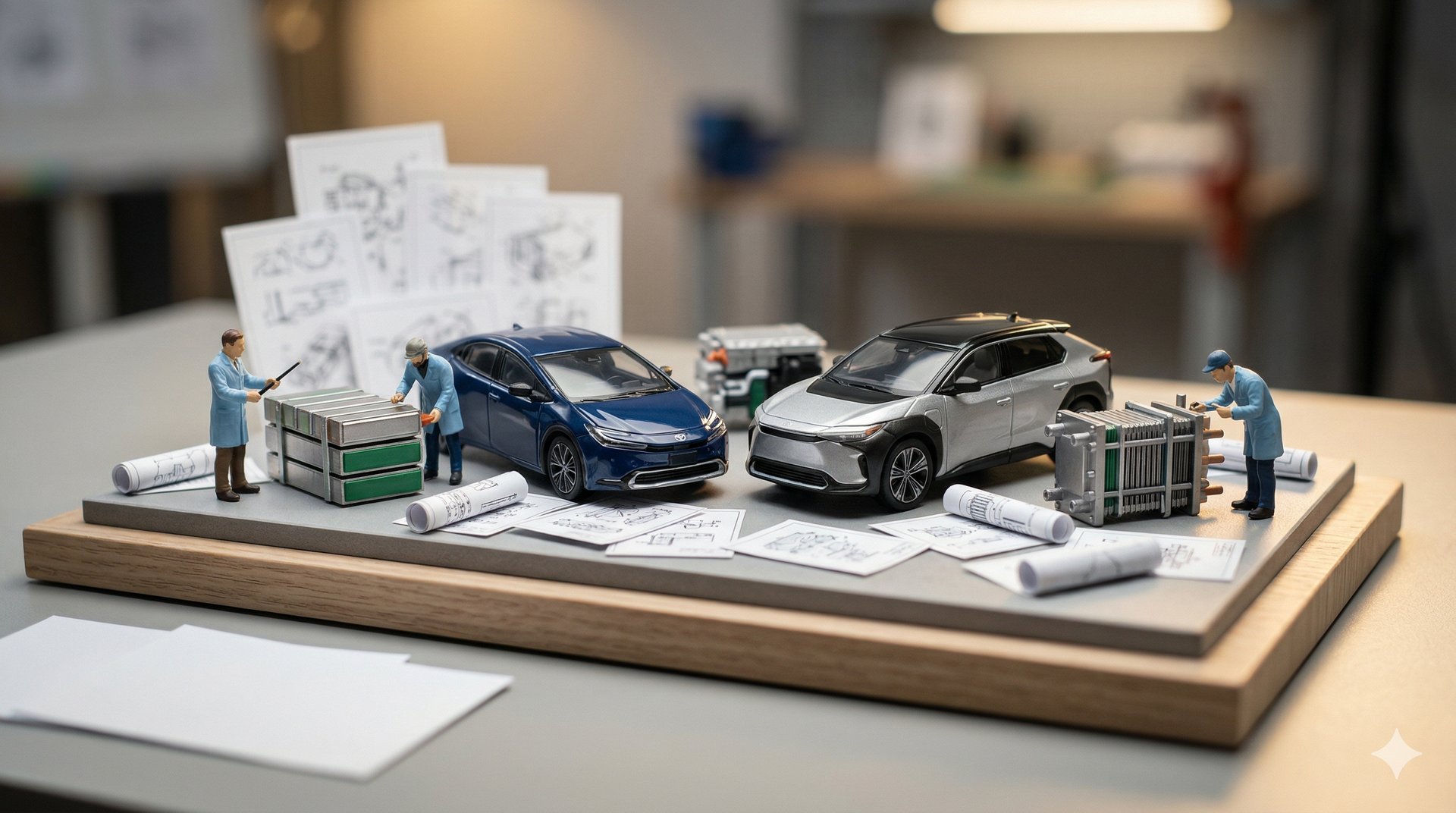
- Toyota’s IP Playbook in the EV Era
- Solid-State Battery Patents: Locking Down the Next-Generation Power Source
- Hybrid Patent Opening: Strategic Retreat to Advance
- Autonomous Driving Patents: The Software-Defined Vehicle Transition
- Fuel Cell Patents: Controlling the Hydrogen Ecosystem
- IP Friction with Chinese EV Makers
- Conclusion: From Defense to Offense in EV-Era IP
Toyota’s IP Playbook in the EV Era
As the automotive industry undergoes its most radical transformation since the invention of the combustion engine, Toyota is deploying a sophisticated intellectual property strategy to navigate the EV revolution on its own terms. With one of the world’s largest patent portfolios spanning solid-state batteries, autonomous driving, and hydrogen fuel cells, Toyota is not simply adapting to the EV transition—it is actively shaping it through strategic IP management.
Solid-State Battery Patents: Locking Down the Next-Generation Power Source
Toyota’s crown jewel in EV intellectual property is its solid-state battery portfolio. By replacing liquid electrolytes with solid materials, solid-state batteries promise simultaneous improvements in energy density, charging speed, and safety—the so-called “holy grail” of EV technology. Toyota is estimated to hold over 1,000 solid-state battery-related patents, making it the global leader in this critical technology space according to EPO landscape analyses.
Particularly valuable are patents covering electrolyte-electrode interface control. The resistance buildup at the contact surface between solid electrolyte and electrode severely degrades cycle performance, and patents solving this problem serve as gatekeepers to the entire technology. Toyota has systematically built an IP fence around this domain in preparation for its targeted solid-state EV launch in 2027–2028.
Hybrid Patent Opening: Strategic Retreat to Advance
In 2019, Toyota announced the royalty-free licensing of approximately 24,000 hybrid vehicle patents—a move that appeared to be IP surrender but was actually a calculated strategic pivot. By enabling competitors to adopt HV technology, Toyota extended the internal combustion engine ecosystem’s lifespan while redirecting its own R&D and IP investment toward solid-state batteries and fuel cells.
The strategy achieves a double effect: partners adopting Toyota’s HV technology generate indirect royalty streams through component supply relationships, while Toyota occupies the higher ground of next-generation technologies. Giving away today’s castle to secure tomorrow’s mountain is classic Toyota long-game thinking applied to intellectual property.
Autonomous Driving Patents: The Software-Defined Vehicle Transition
Toyota Research Institute (TRI) has been filing aggressively in the autonomous driving space, building patent clusters around three pillars: the Guardian cooperative driving system that augments rather than replaces human drivers, sensor fusion architectures combining LiDAR, cameras, and radar, and machine learning-based path prediction. Notably, Toyota—traditionally a mechanical engineering IP powerhouse—is rapidly expanding its software patent filings covering algorithms, data pipelines, and UI/UX, reflecting the industry-wide shift toward software-defined vehicles (SDVs).
Fuel Cell Patents: Controlling the Hydrogen Ecosystem
Unlike competitors committed to battery-electric-only strategies, Toyota champions a multi-pathway approach that includes fuel cell EVs (FCEVs). Following the success of the Mirai, Toyota opened approximately 5,700 fuel cell patents royalty-free in 2021 to accelerate hydrogen infrastructure development. By growing the FCEV market, Toyota protects its vertically integrated IP position spanning fuel cell stacks, control systems, and hydrogen storage—a classic “grow the pie, then take the biggest slice” IP strategy.
IP Friction with Chinese EV Makers
The rapid rise of BYD, CATL, NIO, and other Chinese EV manufacturers is creating new IP tension zones. In drivetrain systems, battery management, and charging control—areas where technical overlap is significant—the risk of patent infringement disputes in European and North American markets is increasing. Toyota’s historical preference for cross-licensing over litigation may be tested as Chinese brands capture market share in regions where Toyota’s IP portfolio is strongest.
Conclusion: From Defense to Offense in EV-Era IP
Toyota’s EV intellectual property strategy is far more than defensive protection of existing technology. It represents an offensive play to capture the commanding heights of next-generation technologies—solid-state batteries, autonomous driving, and hydrogen—while using strategic patent openings to shape the broader ecosystem in Toyota’s favor. Whether this multi-front IP campaign can compensate for Toyota’s late start in mass-market BEVs will be one of the defining IP narratives of the automotive decade ahead.
この記事について
パテント探偵社 編集部
知的財産の世界で起きている出来事を、ジャーナリズムの手法で報道・分析する独立メディア。特許番号・法的根拠・当事者名を正確に記述しながら、専門家以外にも読みやすい記事を届けています。掲載内容は法的アドバイスではありません。


コメント