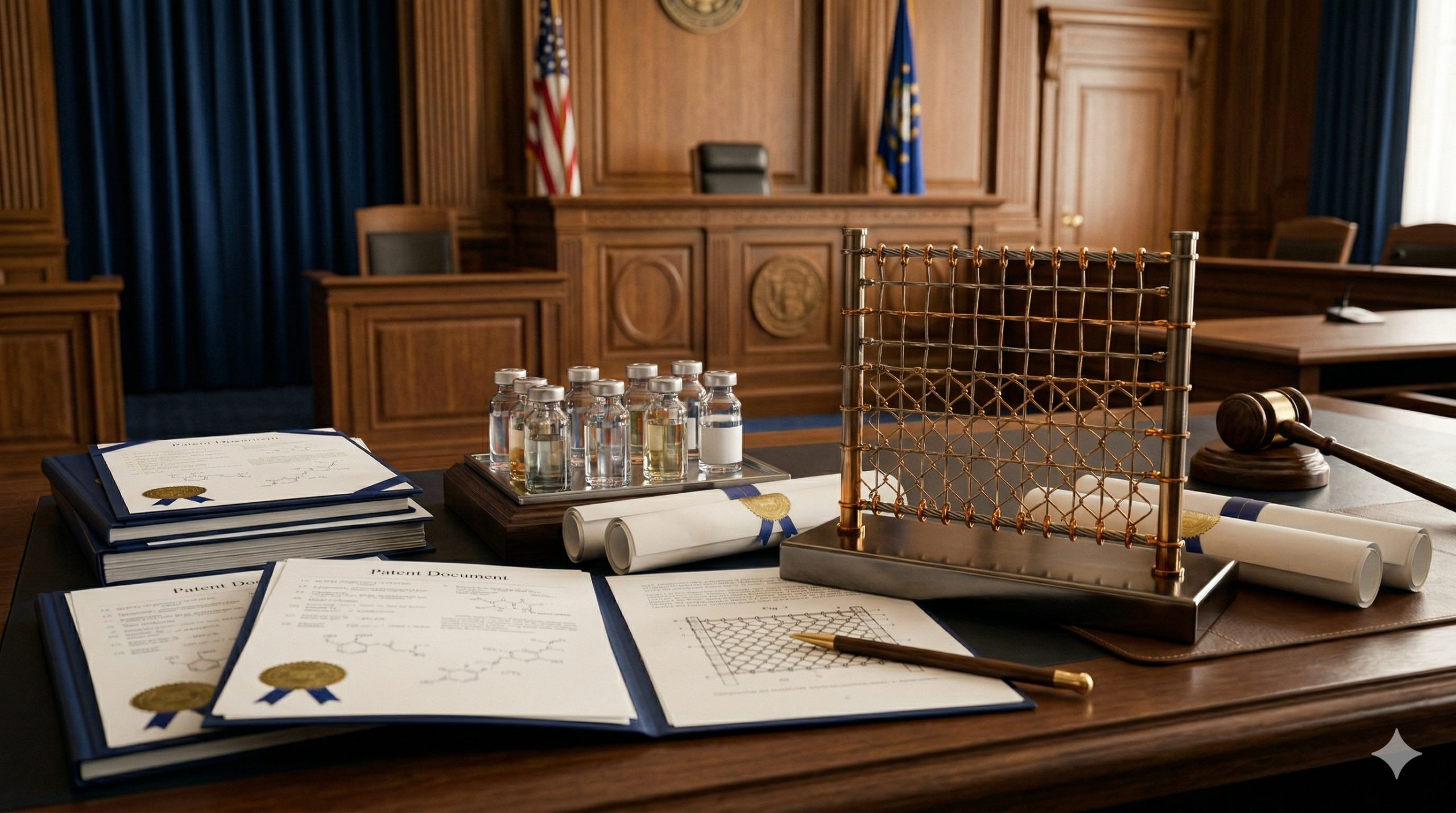
The U.S. Court of Appeals for the Federal Circuit issued a precedential opinion on April 2, 2026, affirming the invalidity of two Fortress Iron LP patents due to the patent owner’s failure to complete the statutory notice procedure required to correct an omitted coinventor. The decision marks the Federal Circuit’s first-impression interpretation of 35 U.S.C. § 256(b)’s “party concerned” notice requirement, establishing a strict procedural threshold for inventorship correction that cannot be waived even when a required inventor is unreachable.
Fortress Iron LP holds U.S. Patent 9,790,707 and U.S. Patent 10,883,290, both titled “Vertical Cable Rail Barrier,” covering vertical cable fencing structures used in construction. The patents became the subject of an infringement lawsuit against competitor Digger Specialties Inc. During that litigation, it emerged that two employees of Fortress Iron’s quality control liaison, Quan Zhou Yoddex Building Material Co., Ltd.—a Chinese building materials manufacturer—had made substantive contributions to the final designs covered by the patents: Hua-Ping Huang and Alfonso Lin.
Fortress Iron successfully added Lin as a coinventor through a correction proceeding under 35 U.S.C. § 256(a). Huang, however, was unreachable—his whereabouts unknown. Despite Fortress Iron’s continued attempts to complete the correction, the district court rejected the application on the grounds that Huang had not received the statutory notice required under § 256(b). The court granted Digger Specialties’ motion for summary judgment, holding both patents invalid.
Writing for the Federal Circuit, Judge Lourie affirmed in a precedential opinion. The court held that Huang qualifies as a “party concerned” within the meaning of § 256(b), and that Fortress Iron’s inability to locate him does not excuse compliance with the statute’s procedural requirements. The court stated: “Section 256 is a ‘savings provision’ only to the extent that its statutory requirements are met. A patent owner’s desire to correct an error does not relieve them of the procedural protections the statute imposes.”
The core legal issue is that the effectiveness of an inventorship correction proceeding depends on the practical availability of the omitted inventor. Where multiple inventors contributed to the patented invention, all must be properly named. When an inventorship error cannot be corrected because a required party cannot be notified, the patent is invalid for that uncorrectable defect. This is the first time the Federal Circuit has addressed § 256(b)’s notice requirement in a precedential ruling, closing off any argument that equitable exceptions might allow a workaround.
The decision carries substantial implications for patent prosecution and portfolio management, particularly where product development involves external partners.
First, the ruling reinforces that inventorship must be correctly determined at the time of prosecution, not reconstructed after litigation begins. When external suppliers, contract manufacturers, or quality control partners contribute substantively to the design or engineering of a patented product—as Yoddex’s employees did here—their potential status as coinventors must be assessed and documented before filing. This is especially critical in cross-border development arrangements, where personnel turnover and changes in business relationships can quickly make inventors unreachable.
Second, from a litigation strategy perspective, the decision confirms that inventorship invalidity is a potent tool for accused infringers. Defendants facing infringement claims should investigate the patent owner’s supply chain and development relationships, particularly where overseas manufacturers or subcontractors were involved in the product’s design. The difficulty of locating foreign partners’ former employees creates a structural vulnerability that this ruling now makes legally actionable.
Third, companies should treat the maintenance of contact information for all contributors to patented technology—including personnel at external partner firms—as a matter of ongoing IP portfolio hygiene. The ability to complete a § 256(b) correction proceeding depends on being able to serve notice on all relevant parties. Losing that capability can be fatal to the patent.
The case underscores a straightforward principle: the obligation to notify omitted coinventors under § 256(b) is not a procedural formality. Failure to satisfy it, for whatever reason, results in patent invalidity. In an era of globally distributed product development, Fortress Iron LP v. Digger Specialties Inc. stands as a clear warning that thorough inventorship identification at the prosecution stage is the only reliable safeguard.
Case reference: Fortress Iron LP v. Digger Specialties Inc., Federal Circuit (precedential, April 2, 2026). Patents at issue: U.S. Patent 9,790,707 and U.S. Patent 10,883,290 (“Vertical Cable Rail Barrier”). Statutory provision: 35 U.S.C. § 256(b). Authoring judge: Judge Lourie.
この記事について
パテント探偵社 編集部
知的財産の世界で起きている出来事を、ジャーナリズムの手法で報道・分析する独立メディア。特許番号・法的根拠・当事者名を正確に記述しながら、専門家以外にも読みやすい記事を届けています。掲載内容は法的アドバイスではありません。


コメント