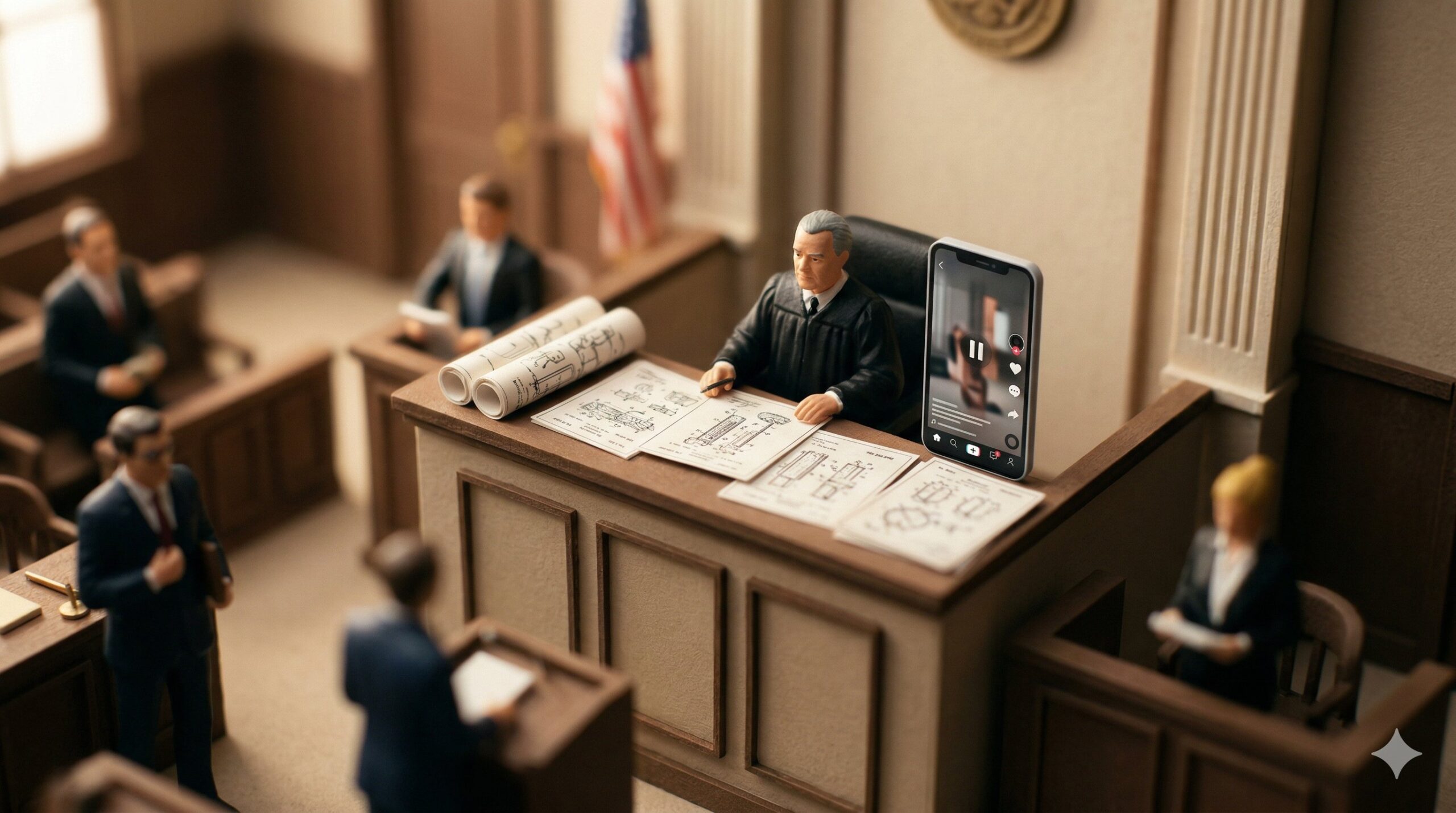
The U.S. Court of Appeals for the Federal Circuit on March 31, 2026 issued a split decision in Tesla, Inc. v. Charge Fusion Technologies, LLC, partially reversing the Patent Trial and Appeal Board’s (PTAB) ruling on U.S. Patent No. 10,819,135. Judge Reyna authored the opinion. The court found claim 1 obvious in light of the Hibi prior art reference under a corrected claim construction, vacated and remanded related dependent claims, and affirmed PTAB’s non-obviousness findings for claims directed to time-based climate control calculations. The decision maps the boundaries of patentable innovation in the increasingly contested field of electric vehicle charging technology.
The ‘135 patent, owned by Charge Fusion Technologies, covers an intelligent electric vehicle charging system designed to maintain cabin climate control—heating or air conditioning—while a vehicle charges. The stated purpose is to protect pets or passengers left inside a parked vehicle during the charging process. The system continues operating climate control until the battery reaches a predetermined charge threshold. Tesla petitioned PTAB for inter partes review, arguing multiple claims were obvious in view of the Hibi reference and other prior art. PTAB rejected Tesla’s arguments and upheld the claims. Tesla appealed.
The Federal Circuit’s first step was to correct the claim construction for claim 1. PTAB had interpreted the claim to require that the climate control mechanism account for changing battery levels during its operation. The CAFC rejected this interpretation, holding that claim 1 only requires the climate control function to continue operating until a battery charge level reaches a predetermined threshold—nothing in the claim mandates real-time responsiveness to fluctuating battery state during operation. This narrower reading of claim 1 opened the door for an obviousness finding.
Under the corrected construction, the court found substantial evidence that Hibi anticipated the core functionality of claim 1. Hibi discloses an automatic air conditioning mode that operates for extended durations, which the court found satisfies the claim’s requirement that climate control continue until a preset battery level is reached. Having reversed the non-obviousness finding for claim 1, the Federal Circuit vacated and remanded dependent claims 2 through 5, 7, and 15 for reconsideration by PTAB in light of the corrected claim 1 construction.
Claims 8 through 11, 14, and 16 were treated differently. These claims require the system to determine “a threshold amount of time” that climate control can continue, based on remaining battery charge. The Federal Circuit affirmed PTAB’s non-obviousness findings for these claims. As the court explained, the patent specification makes clear that “the system cannot accurately notify the user of the 15-minute threshold without determining when the car will deplete the battery at the current A/C setting.” Because Hibi contains no teaching about the relationship between climate control operating duration and battery charge consumption rate, these claims address a technical problem that Hibi leaves unsolved, and they survive as non-obvious.
The decision establishes a meaningful distinction between two categories of climate control patent claims in the EV space. Simple trigger-based claims—”keep running until battery drops below X percent”—face elevated obviousness risk given the availability of prior art references describing automatic temperature management in vehicles. By contrast, claims incorporating duration calculations derived from real-time battery consumption modeling, combined with user notification functionality, enjoy stronger protection because they require algorithmic sophistication absent from the prior art.
EV charging-related patent litigation has intensified in recent years as automakers and charging infrastructure companies accumulate competing IP portfolios. As reported by IPWatchdog, the Tesla v. Charge Fusion decision illustrates that even within a single patent, claim scope dramatically affects patent durability. The remanded PTAB proceedings for claims 2 through 5, 7, and 15 will determine the full scope of protection remaining in the ‘135 patent. For Tesla and other EV manufacturers challenging climate control patents, the ruling offers a road map: target broad trigger-based claims while anticipating stronger resistance against time-calculation and user-notification limitations.
この記事について
パテント探偵社 編集部
知的財産の世界で起きている出来事を、ジャーナリズムの手法で報道・分析する独立メディア。特許番号・法的根拠・当事者名を正確に記述しながら、専門家以外にも読みやすい記事を届けています。掲載内容は法的アドバイスではありません。


コメント