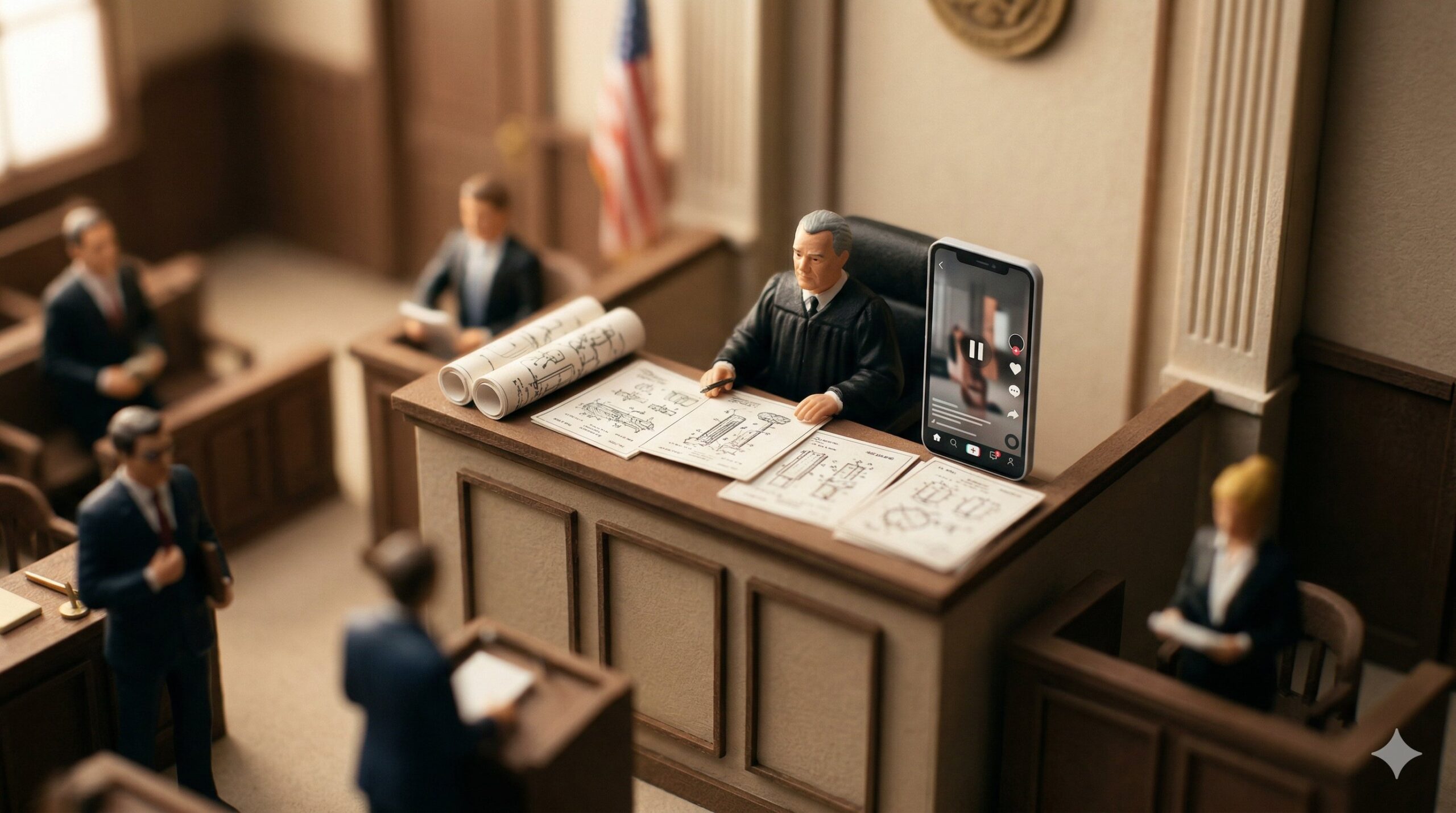
The U.S. Court of Appeals for the Federal Circuit on March 31, 2026 affirmed a district court judgment finding claim 1 of U.S. Patent No. 8,856,030 patent-ineligible under 35 U.S.C. § 101, delivering a decisive win to TikTok Inc. and ByteDance Ltd. in their defense against a patent infringement suit brought by 10Tales, Inc. (Case No. 24-1792). Judge Reyna authored the opinion. Applying the two-step framework from Alice Corp. v. CLS Bank International, 573 U.S. 208 (2014), the court held that the claimed invention is directed to an abstract idea and contains no inventive concept sufficient to transform that idea into patent-eligible subject matter.
The ‘030 patent covers a system for customizing or personalizing a stream of content presented to a user based on information retrieved from that user’s social network. 10Tales filed suit in the Western District of Texas; the case was subsequently transferred to the Northern District of California. The district court initially denied TikTok’s Rule 12(b)(6) motion to dismiss, requiring claim construction to proceed first. After a claim construction order issued, the district court granted TikTok’s Rule 12(c) motion for judgment on the pleadings, concluding that claim 1 was ineligible under § 101. The Federal Circuit affirmed.
At Alice step one, the court assessed whether the claims are directed to an abstract idea. 10Tales characterized claim 1 as directed to “modifying a stream of content based on retrieved social network information,” arguing this formulation describes a sufficiently concrete implementation. The Federal Circuit rejected this framing. The court observed that claim 1 lacks specificity about how the claimed result is achieved and merely describes a result—presenting personalized content based on user information—without identifying the technical means. The court held that “the claim is drawn to the underlying idea itself, i.e., presenting personalized content to a user based on information about the user,” placing it squarely within the abstract-idea category.
At Alice step two, the court examined whether any additional element or combination of elements amounts to an inventive concept. 10Tales advanced two arguments. First, it pointed to the external data retrieval limitation—the claim’s requirement that social network information be obtained from an external source—asserting this was novel and not present in the prior art. The Federal Circuit was unpersuaded, reiterating the established principle that a claim covering a new abstract idea remains an abstract idea: “[A] claim for a new abstract idea is still an abstract idea,” and § 101 inventive concepts are analytically distinct from § 102 novelty. Second, 10Tales invoked a “rule-based substitution” limitation, but the court found this element, without a definitive claim construction establishing its specific content, insufficient to provide a transformative inventive concept.
The outcome continues a well-established line of Federal Circuit decisions rejecting broad content personalization patents under § 101. The underlying concept—tailoring displayed content to individual users based on information about them—is foundational to modern social media platforms, but attempts to claim this functionality in general, result-oriented terms have consistently failed under post-Alice doctrine. The court’s reasoning emphasizes that what a claim accomplishes, rather than how it accomplishes it, is the critical inquiry, and claims that describe outcomes without specifying concrete technical implementations remain categorically abstract.
For IP practitioners, the decision reinforces existing guidance for drafting software and internet patents in the content personalization space. Claims must articulate specific technical solutions—particular algorithms for data retrieval and processing, defined computational steps for matching user attributes to content libraries, concrete system architectures—rather than broadly claiming the concept of personalized content delivery. General limitations such as “retrieving social network data” and “applying rules to substitute content” without further structural or functional specificity will not satisfy the § 101 inventive concept requirement.
TikTok and ByteDance have faced increasing patent litigation exposure in U.S. courts in recent years. This case, involving a § 101 eligibility challenge to a content personalization patent, is analytically distinct from separate reported proceedings involving TikTok as a petitioner in inter partes review. As covered by IPWatchdog, the Federal Circuit’s affirmance in 10Tales v. TikTok represents a complete defense victory on eligibility grounds, requiring no analysis of infringement or damages. As AI-powered recommendation systems become more technically sophisticated, the § 101 landscape for related patents will continue to evolve, but claims framed around abstract personalization concepts without technical specificity will remain vulnerable.
この記事について
パテント探偵社 編集部
知的財産の世界で起きている出来事を、ジャーナリズムの手法で報道・分析する独立メディア。特許番号・法的根拠・当事者名を正確に記述しながら、専門家以外にも読みやすい記事を届けています。掲載内容は法的アドバイスではありません。


コメント