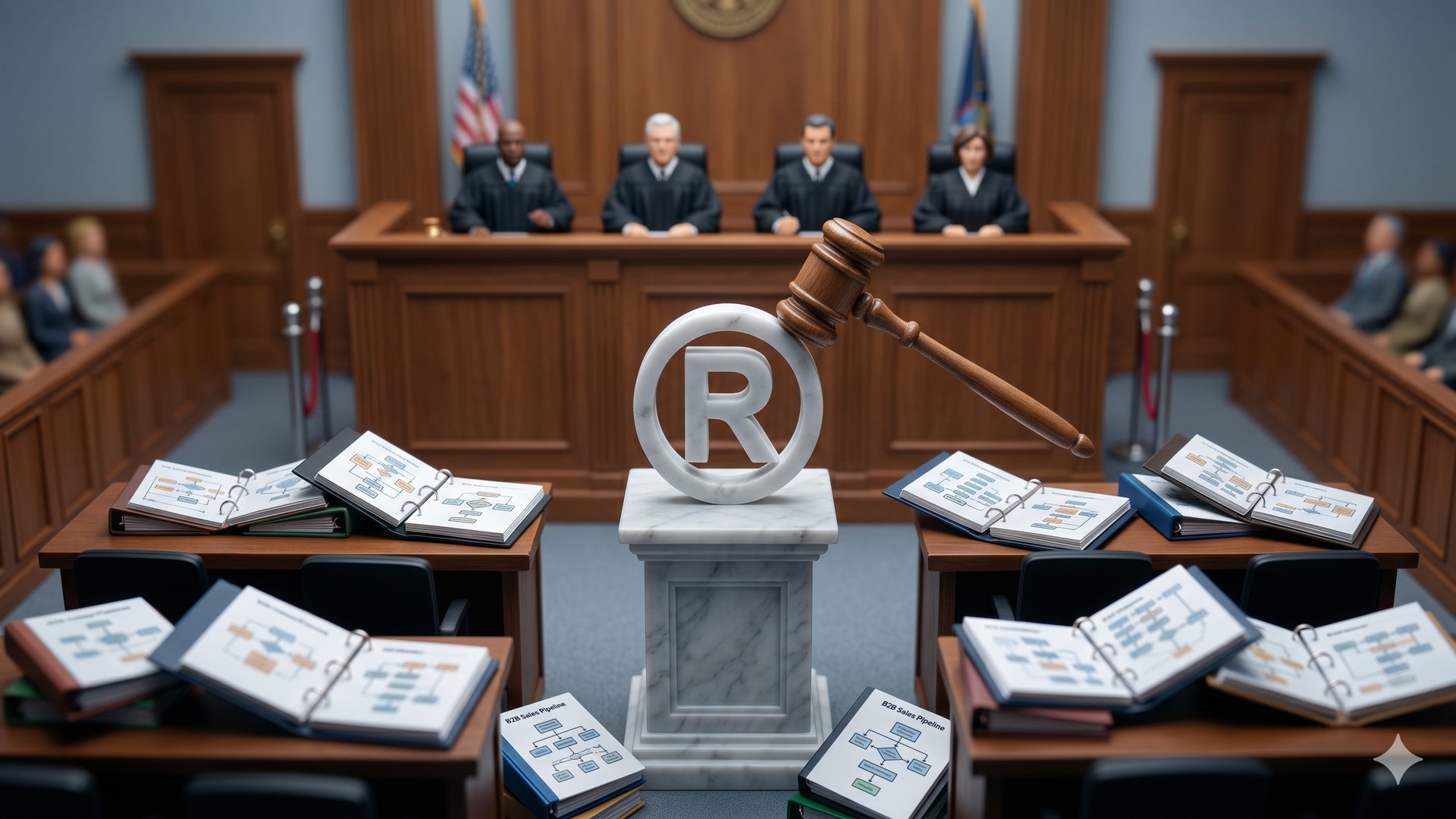
Chief Judge Wendy Beetlestone of the U.S. District Court for the Eastern District of Pennsylvania granted summary judgment in favor of MEDDICC Ltd. on April 21, 2026, ruling that MEDDPICC — the widely adopted B2B enterprise sales qualification framework — is a generic term and cannot be owned as a trademark. The court ordered the USPTO to cancel Registration No. 6,489,058, held by Darius Lahoutifard of 01 Consulting LLC, doing business as MEDDIC Academy. The ruling resolves a two-year dispute that had already caused LinkedIn post removals, YouTube video takedowns, Amazon book listing deletions, and temporary social media account suspensions across the MEDDPICC practitioner community.
What Is MEDDPICC?
MEDDPICC stands for Metrics, Economic Buyer, Decision Criteria, Decision Process, Paper Process, Identify Pain, Champions, and Competition. The framework is an extension of the MEDDIC sales qualification methodology first developed within PTC’s enterprise sales organization in the 1990s. Over the following three decades, MEDDPICC became widely used among enterprise software and SaaS companies managing complex, high-value sales cycles. Its adoption spread as a shared industry resource, taught by consultants, documented in books, and discussed openly on professional platforms — without any association with a single commercial source.
Background of the Dispute
Lahoutifard obtained a federal trademark registration for MEDDPICC in 2021 (Registration No. 6,489,058; Serial No. 88845076). He subsequently used that registration to enforce against MEDDICC Ltd. and others, sending takedown notices that resulted in the removal of LinkedIn posts, YouTube videos, and Amazon book listings relating to MEDDPICC training and methodology content. Social media account suspensions followed. MEDDICC Ltd. — a company founded in 2020 with the stated aim of becoming the global authority on the MEDDPICC sales methodology — filed suit in the Eastern District of Pennsylvania in 2024, arguing that Lahoutifard held no protectable trademark rights in the term.
The Court’s Ruling
Judge Beetlestone granted MEDDICC’s motion for summary judgment in full on the trademark claims. The court found as a threshold matter that Lahoutifard “was not involved in MEDDPICC’s conception,” yet registered the term as a federal trademark sixteen years after its genesis in the industry. On the merits, the court held that MEDDPICC functions as a generic designation for the type of sales qualification framework it describes — not as a source identifier for any particular company’s products or services. Because a generic term cannot qualify for trademark protection under the Lanham Act regardless of registration, the court directed the USPTO to cancel the registration. Every counterclaim advanced by Lahoutifard was dismissed with prejudice, including trademark infringement, trademark counterfeiting, unfair competition under federal and Pennsylvania law, and violations of the Pennsylvania Unfair Trade Practices and Consumer Protection Law.
Implications for IP Practice
The case presents a fact pattern distinct from the classic genericide scenario, where a once-distinctive trademark loses protection through widespread public use. Here, the term MEDDPICC was generic from the outset of Lahoutifard’s registration — it was already a common category name in the sales methodology space before any trademark claim was asserted. The ruling confirms that registration alone does not create enforceable trademark rights where a term already functions as the name of a class of methodology rather than the identifier of a single commercial source.
For IP practitioners advising clients in consulting, SaaS, and methodology-driven industries, the decision reinforces the importance of assessing, prior to filing, whether a proposed mark actually performs a source-identifying function in its relevant market. Where a term has already diffused widely as industry common parlance — in books, training programs, and professional discourse — the likelihood of successfully asserting trademark exclusivity diminishes substantially, and the reputational and legal costs of attempting to do so, as illustrated here, can be considerable.
この記事について
パテント探偵社 編集部
知的財産の世界で起きている出来事を、ジャーナリズムの手法で報道・分析する独立メディア。特許番号・法的根拠・当事者名を正確に記述しながら、専門家以外にも読みやすい記事を届けています。掲載内容は法的アドバイスではありません。


コメント