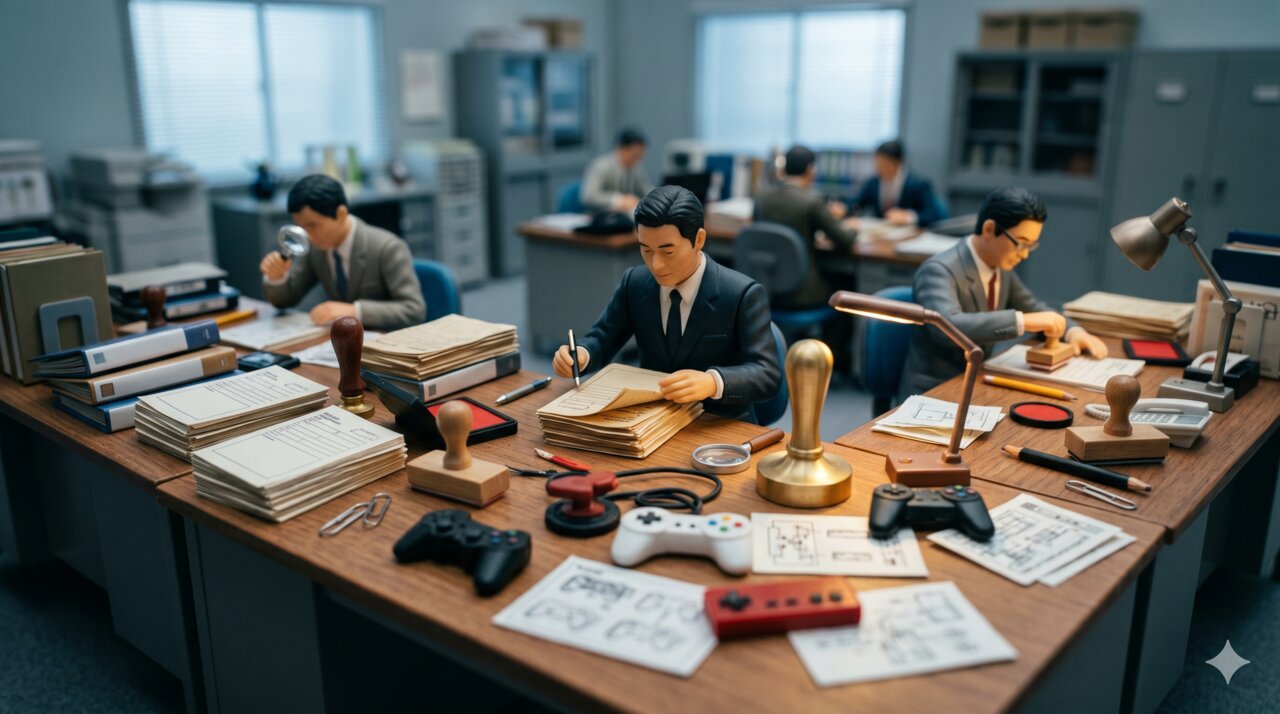
The Japan Patent Office (JPO) has rejected more than 20 Nintendo Co., Ltd. patent applications directed to monster-capturing game mechanics, citing lack of novelty and extensive prior art. Examiners identified existing titles including ARK: Survival Evolved, Monster Hunter 4, Craftopia, and Pokémon GO as prior art references establishing that similar interactive systems were publicly known before Nintendo’s filing dates. The rejections, disclosed in April 2026, carry potential implications for Nintendo’s ongoing patent infringement lawsuit against Pocketpair, Inc. over the smash-hit title Palworld.
Nintendo and The Pokémon Company filed suit against Pocketpair in Tokyo District Court in September 2024, asserting that Palworld infringes Japanese Patent No. 7505852 and No. 7545191. Both patents claim game systems in which a player character captures monsters on an open field. Palworld sold over 20 million copies within a month of its January 2024 launch, drawing immediate comparisons to the Pokémon franchise for its creature-collection mechanics and character aesthetics. Pocketpair has consistently denied infringement.
Application No. 2024-031879, one of the applications now rejected by the JPO, is described as closely related to the two patents currently at issue in the litigation. In its rejections, the JPO cited ARK: Survival Evolved’s creature-taming system, Monster Hunter 4’s monster-capture mechanics, Craftopia’s creature-capture feature, and Pokémon GO’s location-based monster-capturing as prior art rendering Nintendo’s applications lacking in novelty. Where these titles were released or publicly disclosed before Nintendo’s filing dates, the JPO found insufficient basis to grant new patent rights.
It is important to note that the JPO’s rejections apply to pending applications, not to the already-registered patents asserted in the lawsuit. The validity of Patent Nos. 7505852 and 7545191 would need to be challenged through a separate invalidation trial (特許無効審判) under Article 123 of the Japanese Patent Act. However, the prior art citations issued by the JPO in these rejections could serve as relevant evidence in any such proceedings. If Pocketpair pursues an invalidation trial, the examiner-identified prior art — particularly ARK, Monster Hunter 4, and Craftopia — would likely feature prominently in challenges to the novelty or inventive step of the asserted claims.
The U.S. Patent and Trademark Office (USPTO) also rejected a Nintendo application in April 2026 related to summoning characters to fight, indicating that analogous rejections are occurring in parallel across jurisdictions. While a USPTO rejection of a pending application does not directly invalidate Nintendo’s existing U.S. patents or affect the Japanese proceedings, the parallel outcomes reinforce the broader view that Nintendo’s monster-related patent portfolio faces meaningful prior art obstacles on both sides of the Pacific.
As of April 2026, the Palworld lawsuit remains active in Japan with no trial date set, and related proceedings continue in the United States. Nintendo has not commented publicly on the JPO rejections. Pocketpair, for its part, is expected to incorporate the examiner’s prior art findings into its litigation strategy, potentially filing invalidation trials against the asserted patents. Nintendo would likely respond by pursuing amended claims or divisional applications to maintain a broader scope of protection around its creature-capture innovations.
The episode highlights a recurring challenge for game companies seeking patent protection over core gameplay mechanics: where multiple commercial titles have implemented analogous interactive systems, demonstrating novelty and inventive step becomes substantially more difficult. Patent examiners are increasingly treating prior game releases as citable prior art documents, applying the same rigor found in software patent examination generally. Game developers pursuing patent protection would be well-advised to distinguish their claimed inventions from predecessor titles explicitly at the drafting and prosecution stage, rather than relying on examiner unfamiliarity with the gaming landscape.
この記事について
パテント探偵社 編集部
知的財産の世界で起きている出来事を、ジャーナリズムの手法で報道・分析する独立メディア。特許番号・法的根拠・当事者名を正確に記述しながら、専門家以外にも読みやすい記事を届けています。掲載内容は法的アドバイスではありません。


コメント